
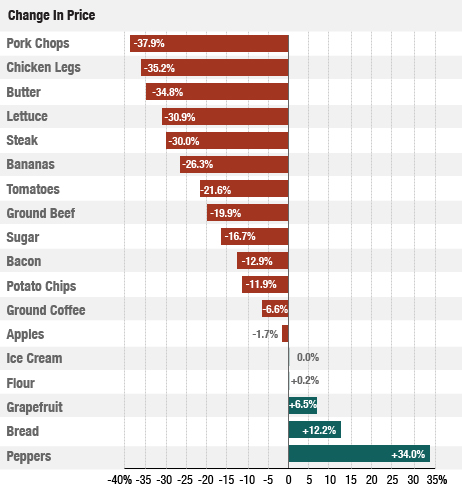
 I was poking around at statistics on food spending this morning and came across some interesting charts.
We spend way less on meat and more on processed food that we did in the past. That info probably comes at no surprise. People are busier, so they buy frozen dinners instead of cooking from scratch. No surprise. But that isn’t the whole story.
People may be spending less of their food budget on meat, because meat is much cheaper. All those horrible meat processing factories have lowered the cost significantly.
Do you buy ethical meat? Or is the cost just too prohibitive?

 Apt. 11d
It is interesting that the fruit & vegetable percentage is the same, but fruit & vegetable costs have largely dropped. That’s actually encouraging.
LikeLike
I’m not sure what ethical meat is. Ethically farmed? Or ethically packed? One of the things I regret is that the meat packing plants of the upper Midwest, formerly staffed by proud, unionized, well-paid workers (so proud that a football team was named after them), have been replaced by plants further south staffed by underpaid immigrants. In fact, low meatpacking wages, and the low wages of the agricultural sector generally, concern me more than the plight of farm animals. (I think my Upper West Side neighbors mostly have the reverse priorities.) However, I don’t think this problem can be solved given current levels of immigration.
To turn back to the more pleasant topic of how we live now, we don’t buy much processed food, but we only buy free-range or grass-fed meat on special occasions, since it’s more expensive and the fancy meat store is farther away. So mostly we buy meat from the local supermarket. I’ve never seen meat that claimed to be raised or packed by union workers or by people earning a decent wage.
LikeLike
Why are peppers so much more expensive? I wonder if “peppers” includes all of them, and people are buying fancier ones or something. (I like peppers, and eat them fairly regularly, but it’s a small enough part of my total food costs that I’ll admit I mostly don’t pay that much attention to how much they cost, and changes in cost.)
I’m fairly likely to buy meat that’s seen as “ethical”, but more because of the taste than the direct ethical concerns. I do think it’s highly preferable to not torture animals before we eat them, and to raise them in ways that don’t lead to significant public health concerns (antibiotic use, bacterial contamination, etc.) but it’s mostly good luck for me that these factors tend to go along w/ much tastier meat. (Also, I mostly shop at the little co-op grocery store in my neighborhood, and many of the people there care a lot about “ethical sourcing” for things. That’s lucky for me, as then I don’t have to think much about it. I just buy whatever they have there that looks good.)
LikeLike
Good point.
I definitely think that the fruit and veggie situation is improving a lot. Locally, it’s lately been possible to buy a pineapple for around a dollar. Pineapples are getting to be a weekly staple at our home, because they’re really quite affordable.
LikeLike
I was trying to respond to Tulip. Sorry!
LikeLike
Ethical meat for me has to do with both the care of the animal and the people. In the summer, I buy most of my meat from a local farmer. Not only are the animals treated fairly, but he employs full time well paid workers, and the cost to me is less than at wholefoods.
LikeLike
Living in ranch country, I’m lucky. I can buy high-quality meat from rancher friends. I’ve probably seen the cows I’m eating. Also eat a significant amount of goose, thanks to hubby’s hunting. I can’t bring myself to buy meat from the store anymore.
LikeLike
Wow, on the link through, the change in the money spent on processed foods from 82 to 2012 (30 years, but the 30 years of our generation, basically) is pretty dramatic.
It fits with the way I behave as opposed to my mother, so, seems anecdotally accurate in my experience. But, I would have considered myself an anomaly in the significant change in the food habits between my family of origin and the family I am raising. Seems I’m not as much of an anomaly as I thought. I guess the rest of you, buying meat from rancher friends and farmers might be the statistical anomalies, rather than me!
LikeLike
Yes and No. We belong to a meat CSA that provides $100 of meat and eggs per month. It is not much meat because it is expensive because it is ethically raised and processed. I only buy ground beef that is ground in the store – no discount logs of ground beef and we have stopped eating fast food ground beef. I don’t buy any pork except from the CSA and Whole Foods because of how they treat pigs, but I will eat it out and still love Eastern NC BBQ – which is not generally made with heritage pigs. I am a sucker for super cheap chicken (even though chickens are not well treated either). I am trying to buy more organic chicken at places like Costco, but I am not above the 99 cents a pound special.
LikeLike