
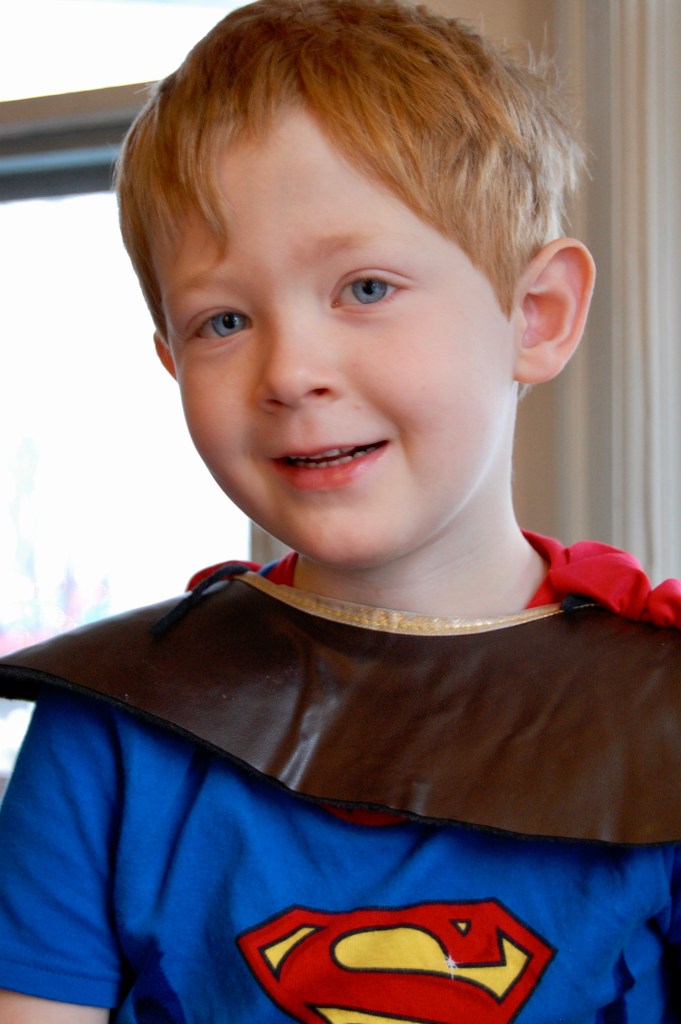
When Ian was three, the local school district sent him to a neurologist to see why he couldn’t talk. After a few background questions for me about my pregnancy and his birth, she turned to Ian, and said, “okay, let’s see what’s going on here.” She pulled out a wooden puzzle with a dozen barnyard animals and dumped them on ground. I smiled and said, “wait until you see this.”
Ian glanced down at the puzzle pieces of the cow and the dog, picked up one by the little peg, and slapped into the wooden puzzle board without hesitating or jiggling the piece to fit it into place. Slap. And it was in. And then he did it again and again. Fast and perfect, without looking at us once to register our reaction and without any comments at all. I handed him a candy reward.
“Wow,” said the neurologist. At the end of the appointment, she said that he couldn’t talk because he was smart. (Yes, doctors really did say that twenty years ago.) As we later learned, Ian is smart, and he’s also autistic. But autism looks differently in every person, and few have Ian’s combination of strengths and weaknesses.
In a viral article for The Free Press — Bari Weiss’s substack — Jill Escher writes that the neurodiversity movement, which celebrates autism and normalizes it, has done real damage to her family. Escher say that those autism advocates do not speak for her or her two profoundly autistic adult-children, completed derailed the effort to find causes of autism, and distracted from the real desperate need to create programs for adults with autism.
Read more at Apt. 11d, the newsletter

 Apt. 11d
On a related note – I just read the first section of Jennifer Senior’s article about the institutionalization of severely disabled children in the Atlantic; an amazing piece of history. It’s a good reminder that people who were identified as “idiots” were ignored and hidden away and seen as capable of nothing.
https://www.theatlantic.com/magazine/archive/2023/09/disabled-children-institutionalization-history/674763/
The autism article is helpful in pointing out the increase in prevalence and powerful as it describes the devastating experiences of the author and her family. I do think Weiss likes articles that blame (or can be angled to blame) “movements” for all parts of a problem when there are so many other things to blame. Everyone needs to support tax dollars to create an enormous safety net for parents with autistic children; and, for that matter, parents with children severely disabled/disadvantaged in any way; or people dealing with disability at any age (dementia, end of life care). Was that support there before the neurodiversity movement? Would it magically appear if the movement went away? I don’t think so.
Everyone needs to support medical research on the causes and cures for severe autism, and the massive increases in prevalence – and it looks like this research is ongoing. I hope they make some progress.
LikeLike
“. Was that support there before the neurodiversity movement? Would it magically appear if the movement went away? I don’t think so.”
Yes, really good points, af.
I had told everyone that I retired from journalism in February, so I could concentrate on advocacy and campaigning. But the president of the really big autism organization wants to do a Q and A with me about this article, so I might not be done yet.
LikeLike
De novo mutations in autism (in gametes of unaffected parents with autistic children or immediately after the formation of the zygote/embryo) is a significant subject of study in the genetics of autism. The Simons Simplex Collection (SSC) is one such example, looking at the genetics of single affected children who have parents & siblings are not autistic: https://www.cell.com/neuron/fulltext/S0896-6273(10)00830-5. The project combines high end genetic analysis with careful phenotyping of autism (to keep the range and variation that occurs in autism). I think Escher is making the argument that autism (and maybe autism with ID) is increasing (and not just being more frequently diagnosed and recorded), that the cause might be de novo mutations (in the gamete line, in families like hers which have more than one child with autism, and would not be included in the SSC) and the increase in de novo mutations might be caused by environmental effects. That hypothesis is being studied.
LikeLike
I was two months pregnant and a mile away from 9/11.
LikeLike
I don’t know enough about these lines of research (interactions between genetics, environment, and epigenetic factors).
The lack of evidence in support of a vaccine/autism link does not mean that there can’t be complex interactions in autism including environmental factors, and I don’t think scientists are arguing that and they are indeed investigating multiple interacting relationships in the ontogeny of autism. An example: an example: https://www.ncbi.nlm.nih.gov/pmc/articles/PMC6369590/
There does seem to be a general consensus that maternal stress (stress that causes a physiological stress response in the pregnant woman) can be associated with autism. In the paper above, the authors examine the relationship (in mice) between the SERT gene (associated with repetitive behaviors in human autism) and exposure to stress that results in an elevated cortisone response. They find a relationship between the missing SERT gene and “decreased social interaction” in mice that are the progeny of dams (mothers) that are missing the SERT gene after exposure to stress.
I haven’t seen a report on 9/11, but, it seems like there should be an analysis of that population (including in exposure to 9/11 toxins).
LikeLike
I’m didn’t connect the dots in my comment, but I think I’m trying to say the parallel to AF’s comment about stories about movements as reasons for action or lack of action. The research does go on, particularly because the system for awarding much of funding for biomedical research, especially for basic science, is in the hands of a very big bureaucracy (NIH) that is difficult to shift (for good or ill). The neurodiversity movement does have influence — Autism Speaks has shifted both its rhetoric and focus. But funding is not all that different and players like NIH and the Simons foundation are where the money is.
LikeLike