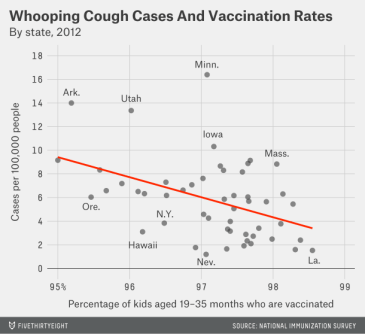
At 538, Emily Oster argues that states need to shoot for a 100% vaccination rate. (And check out Minnesota!)
Leave saving the world to the men? I don't think so.

At 538, Emily Oster argues that states need to shoot for a 100% vaccination rate. (And check out Minnesota!)
Comments are closed.

 Apt. 11d
What are we supposed to learn from Minnesota other than there is variation? They appear to have the same vaccination rate as Nevada. So.. check out Nevada?
LikeLike
The linked article is fairly bad, as an example of writing about statistics and epidemiology (Oster appears to be an economist at UChicago, and I’d expect more from that affiliation, perhaps an attempt to talk to the general reader that has failed? or her expertise is more business oriented, rather than economics?). I think she’s trying to point out that whooping cough is different from measles, in requiring a higher rate of vaccination before “heard immunity” can be expected? But the math (collapsing into quintiles, comparing them) is seat of the pants analysis that isn’t particularly appropriate to support the general hypothesis (though I am not an epidemiologist.
It’s already known that the whooping cough vaccine seems different from others, among other things, because older vaccines provided shorter term immunity. In addition, in the different graphs she compares have rates for kindergartners, for everyone to 19-35 mo vaccination rates. Given that whooping cough vaccines have both changed over time, and seem to offer less long lasting immunity results in potential confounds.
Eye ball analysis might argue that Arkansas, Utah, and Minnesota (the high outliers) look more off the line than Nevada (or Hawaii). Oster actually does “eye ball statistics” (Ugh, I’m not supporting it).
LikeLike
oops, “herd immunity”.
LikeLike
She is also using just one year of data (illustrative, but that is it for immunity). The outliers in 2012 may be on the line in 2013 or 2011 etc. My point is that Minnesota as an outlier tells us nothing without more information, so saying check out Nevada is just as valid.
LikeLike
I’m not technically an epidemiologist but I have committed epidemiology under the supervision of one. While I am not going to read that article, I will note that there is nothing inherently half-assed about division into ordered groups like quintiles.
LikeLike
Since I haven’t even committed epidemiology, I can’t argue that it is unacceptable in this instance, but in other fields, dividing into subgroups can be evidence of trolling for statistical significance. The trolling is less likely when the groups aren’t arbitrary (i.e. quintiles), but only if the analysis didn’t also involve looking at quartiles, . . . .
LikeLike
I actually read the article. There is nothing unreasonable about that analysis using quintiles. The findings are very clearly nonlinear and to split the data into categories is the most common way of looking at that nonlinearity.
Just in general I object to the idea that the strategy of grouping cases is especially indicative of trolling. But in this case it is very clear that if anyone ran that analysis using the full range variable, proper diagnostic steps would have lead them to switch to some method like the one used.
LikeLike
Also, somebody like bj please correct me if I’m wrong, but isn’t 100% vaccination physically impossible?
A number of children simply cannot be vaccinated for their own safety, hence the importance of everybody else doing it.
LikeLike
Hey, I just had that discussion with my kiddo, and, yes, 100% vaccination is not possible. But, as we discussed, it could be that 99.5% or 99.9% vaccination is possible. I don’t know what percent of the population are contraindicated for vaccination
LikeLike
Here’s a Massachusetts public health advisory from 2013, covering the 2012 outbreak: http://www.mass.gov/eohhs/docs/dph/cdc/immunization/advisory-pertussis-20130815.pdf.
100% immunization of 19-36 month olds wouldn’t have made a huge difference, because, to quote, The recent outbreak, consistent with what has occurred nationally, demonstrates that vaccinated individuals may develop pertussis, and that illness may be less severe among vaccinated individuals, as compared to unvaccinated individuals.
In Massachusetts, although the majority of confirmed pertussis cases in 2012 were in adolescents and adults, the highest incidence rates were among infants under the age of one, and there was one pertussis death in an infant.
So, the vaccine may not be that effective. According to the document, the majority of Massachusetts adults have not received a dose of Tdap.
Can we stop blaming parents? Please? And stop writing articles which assume childhood vaccination is the one method to control disease? The need for adults to receive vaccine boosters should be covered, shouldn’t it?
LikeLike
First dose for babies for pertussis is at 2 months, precisely because it makes a huge difference in survival rates. Pertussis has really specific issues with vaccination (I heard a good talk on it) and yes, part of protecting babies is for all the adults to get the booster. But it is an unusual one.
LikeLike
Yes, pertussis is odd, which is one of the problems I had with the seat of the pants analysis done by Oster.
http://www.cdc.gov/pertussis/about/faqs.html
LikeLike
I got a Tdap booster when I found out my first grandchild was on the way.
LikeLike