
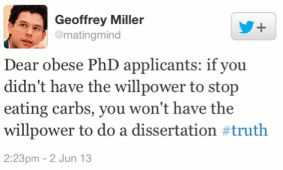
Rachel Fox says that she cannot continue her career as a scientist, because there is too much discrimination against overweight scientists.
The problem with being a fat scientist is that, as a scientist, I’m supposed to know better. Science is all about rules, laws, and logic that can be applied to even the most complicated systems. Most scientists subscribe to the notion that losing weight is a simple matter of biochemical thermodynamics: calories in versus calories out. Despite dozens of studies that complicate this reductionist narrative (including Tara Parker-Pope’s notorious report“The Fat Trap”), it’s still the most prevalent belief I’ve faced during my time in the STEM disciplines.


Trolls should be ignored.
LikeLike
In what profession are people *not* biased against obesity?
Miller appears to have encountered some pretty tough sanctions: that he will not be on any committee involving the admission of graduate students — officially stating his bias might reasonably have something to do with that sanction), faculty mentoring to discuss his bias (for 3 years!), close supervision by the chair, . . . .
LikeLike
One of the local grad students is tubby and has a bad complexion (but he is married–yay!).
However, he’s smart, nice and he’s an excellent organizer and any college would be lucky to have him.
LikeLike
Well, in general fat women are stigmatized more than fat men. Men are described as heavy, big, broad and of course jolly; large women are just fat and/or huge.
LikeLike
We could use the same principle about drinking beer, staying up too late, watching TV, checking email, etc. and easily end all of the purported problems with an over-supply of PhD students. I might be in favor of it, so long as no one applied it to me. (Plus, there’s nothing wrong with carbs as such.)
LikeLike
The Fat Trap is a good article. I particularly liked the description of the full time job it is to keep the weight off, for the couple profiled, the Bridges. The article describes detailed measurements of consumption and energy expenditure — I’m guessing that many of the people we imagine as being “naturally thin” do that automatically. I think that like so many human endeavors, some people have to work very hard at something that comes easily to others, for reasons of habit or biology or genetics. Maintaining weight will be a struggle for some, while dealing with rapidly changing schedules is for others, or doing without sleep, or doing math, or reading long texts, . . . .
I think the reliance on biology as the justification, say, for why we shouldn’t be biased is a foolish one. To the extent that bias against the obese is based on stereotype (i.e. fat people are lazy) it’s imperative to figure out if the person you are talking to is lazy, slow, stupid, rather than relying on an unreliable stereotype (and, they all are, since there will always be an exception, even if there were a correlation).
LikeLike
The original tweet said, “if you don’t have the willpower to stop eating carbs, you won’t have the willpower to do a dissertation.”
Come to think of it, that’s not how willpower works. There’s been some research to the effect that willpower is a limited resource:
“A key experiment by Roy Baumeister, Ellen Bratslavsky, Mark Muraven and Dianne Tice in 1998, demonstrated some of the first evidence that ego depletion has effects in many diverse contexts or situations.[1] They showed that people who initially resisted the temptation of chocolates were subsequently less able to persist on a difficult and frustrating puzzle task. They attributed this effect to ego depletion, which resulted from the prior resisting of a tempting treat. Additionally, it was demonstrated that when people voluntarily gave a speech that included beliefs contrary to their own, they were also less able to persist on the difficult puzzle, indicating a state of ego depletion.”
http://en.wikipedia.org/wiki/Ego_depletion
LikeLike
That’s why I always drink. So I can save my strength for dangerous temptations.
LikeLike
Rachel Fox’s experience is probably partly shaped by the fact that there are a lot of people with poor social skills (and perhaps poor verbal filters) in the sciences.
It may well be that she will do better in a field with a higher average level of social competency.
LikeLike
Yes, possibly, that the bias will be similar, but the likelihood of blurting out the bias will be less. A thought I had in reading her story was under what conditions a colleague/friend/other observer would try to regulate the eating of another adult. Clueless social behavior might be one. I also wondered if size plays a role. I am not thin, but I cannot imagine another adult trying to regulate what I was eating (well, except my family members, who do sometimes). I would expect bias against fat to be of the sort where one would just assume that someone was lazy or part of the general bias against less attractive people (i.e you don’t get hired as the spokesperson for a group if you aren’t generally attractive). The incident where someone tried to stop her from eating sounded out of the norm. Do some group of people encounter this regularly? (say, like waitresses trying to regulate the alcohol intake of a pregnant woman, do waitresses suggest that one order something different?).
LikeLike
“A thought I had in reading her story was under what conditions a colleague/friend/other observer would try to regulate the eating of another adult.”
When the speaker is obsessive?
http://www.slate.com/articles/video/dear_prudence/2014/06/dear_prudence_video_food_monitor_boss.html
LikeLike
Sometimes it’s indirect, like when people say “Oh, I couldn’t eat a donut, I’m trying to diet” with a tone of voice that implies you should be dieting too. Or they say “What mean person brought cake to the office? Now I’ll have to have a piece because I haven’t any self-control.”
LikeLike
Somebody brought a dozen donuts into the office. I ate three of them. I’m far less than 1/4 of the office.
LikeLike
MH said:
“Somebody brought a dozen donuts into the office. I ate three of them. I’m far less than 1/4 of the office.”
By weight?
(Sorry!)
LikeLike
Both the other men were out that day.
LikeLike