
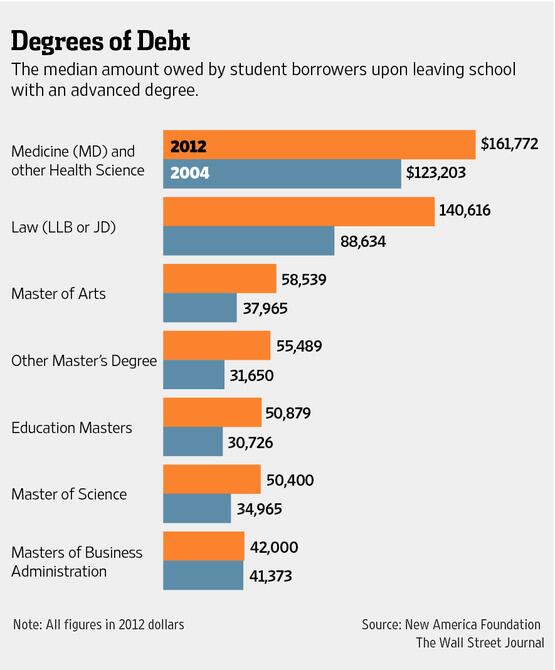
 According to a report from New America Education Policy Program, the typical debt for students who graduated with a Masters in Art in 2012 is $58,539, which is up more than $20,000 from 2004. That means $494 in monthly payments.
They also looked at other graduate programs and found that these programs accounted for a huge chunk of the growing student debt problem. There were dramatic spikes in graduate degrees in law, medicine, education, and business. They didn’t break down debt for PhDs in this report. Too bad. I would have liked to see that.
The MA number is particularly troubling, because there’s no earthly reason to get an MA. Other graduate degrees usually pay off with higher salaries. If you’re a teacher, your salary is based on years of experience and education. So, a master’s degree debt is balanced out with a higher salary. It’s probably worth the investment. A medical degree will pay for itself eventually. A law degree is probably more a long shot.
However, what is the payoff for a MA in sociology or English? And how many people are actually getting terminal MA’s in the humanities and social sciences? Does that number include students who drop out of PhD programs after they get the MA?

 Apt. 11d
Ahem. I have an M.A. in a social science. I don’t think I would have gotten interviewed for at least two of the positions without it even if I had the same skills and could demonstrate them independently. I came by it honestly (and cheaply), dropping out of a Ph.D. program. I’ve since hired another guy with the same degree. We would have tried to hire him without the degree, but we probably wouldn’t have been allowed to offer enough money for him to take it.
LikeLike
Federal government employees can often get hired at a higher pay scale for having something like “a graduate degree in a social science discipline.” It’s the same pay bump regardless of whether you have an MA from Harvard or the University of Phoenix, which explains the proliferation of all of the fly by night graduate programs.
I teach in a grad program and we often get students who didn’t do well in undergrad who hope to do well in an MA program in order to get into a PhD program (which is a whole other kettle of fish, and something to be discussed at another time).
Many school districts will pay teachers more for having an MA, and many states require that they get “an MA” at some point in their tenure in the school district. Some teachers, at least in my experience, seek out whatever degree is perceived to be easiest, since often there are no specific requirements as to the type of degree. (I.E. Most math teachers don’t get an MA in math. We had one who got an MA in counseling and another in home economics.)
LikeLike
Yeah–teachers don’t specifically need ed MAs to get the salary bump, do they? It just needs to be an MA of some kind.
LikeLike
I just needs to be a Masters degree. I thought it was usually a Master of Education (M.Ed.) that teachers got. M.A. is Master of Arts.
LikeLike
I don’t think they should be lumping the MSW in with the MFA. It’s more of a pre-professional degree and it pays off especially if you get clinical licensure.
LikeLike
It’s interesting that the MBA is not more debt-inducing than it was a decade ago.
I suspect that’s because a lot of people do MBAs while working (which means they are not living off of student loans, just paying tuition) and a lot of people still manage to have employers pay for MBAs.
LikeLike
I wonder if part of the increase is because more people without family wealth are going to graduate school, either because large debts are now seen as more normal or because they can’t find jobs and don’t know what else to do.
LikeLike
bj and I have brought this up on previous threads–more and more, student loans have become a sort of DIY unemployment program. There’s really no other way of borrowing living expenses on such reasonable terms.
LikeLike
Two words: civil service. Civil service grades are on a point system, and having an MA grants one a considerable point advantage over a person without. A friend is a warehouse superintendent for a public entity; all the interviewed candidates for what amounts to a recent “warehouse manager” position had MAs. A person with just a BA wouldn’t have gotten their foot in the door.
You can argue that “credentialing” is a bad thing, and I’d half-agree. But that isn’t going to change anytime soon, so I’d be reluctant to tell anyone to stick with the minimum.
LikeLike
And in case anyone is wondering why I’d half-agree: higher education is still a workaround for women going up against the “good old boy” network (which doesn’t seem to be a thing UMC women in major metropolitan areas complain about on the internet; they seem to think that’s a thing of the past. For the rest of us, trust—it’s still A Thing). Getting credentials can give you a boost if you’re shut out of the golf games, hunting trips, motorcycle clubs, men-only social or service clubs, etc. Having stronger credentials than the men gives them pause for the cause if they’re thinking about denying you opportunities in favor of their drinking buddy. Just sayin’.
LikeLike
Related — MA degrees don’t improve teaching… http://www.brookings.edu/blogs/brown-center-chalkboard/posts/2014/06/05-masters-degree-pay-bump-chingos?utm_campaign=Brown+Center+on+Education+Policy&utm_source=hs_email&utm_medium=email&utm_content=13097080&_hsenc=p2ANqtz–kobIjBqS40od8zeGR6xtcN_bFJamVJ28ZG1deQZgarkCMQotJJ1NCTNy8u0jbN0izExvT3BFtDZOien7mLlGpSdlhsQ&_hsmi=13097080
LikeLike
I am told (i.e., by a paralegal who left us to go back to grad school) that some Ph.D. programs want students who have M.A.’s (even if they had good undergraduate grades). So it might make sense to get a M.A. from School 1 as a prelude to applying to the Ph.D. program at School 2. If you do that, you will show up in the statistics as the possessor of a terminal M.A. degree from School 1. All in all, based on the various comments, it seems that a goodly percentage of the terminal M.A. degrees awarded are not ill-advised.
There is a blogger, Jane the Actuary, who dropped out of a Ph.D. program, with a M.A., and who seems to have done fine, though I don’t know if the M.A. helped her. She is on my list of mommybloggers with graduate degrees. Most of the blogs I read are in that category.
LikeLike
I think around 70% of people in my program come in with terminal MAs. If you want to go to a top program in my field with funding, it usually requires a terminal MA (or JD, MD, or PhD in a separate discipline, for that matter). Not everyone gets one but it can pay off in the long run if you want to be a professor in my discipline. Clearly it’s a very risky proposition, but it’s one of a series of calculated risks that can pay off for some people. Top programs in my field have very high TT rates–around 80-90%. Almost all the professors come from about 5 schools, so if you want to have a realistic shot at a job you really have to go to one of those schools. At the same time, I also know some people who’ve left my program who are putting their (in some cases multiple) MAs to good work. E.g., working as an academic librarian can require an MLS as well as an MA or MS in a particular academic discipline.
LikeLike
I have a relative who completed an MFA not long ago, as an adult. She’s teaching and selling her art. It can work.
She does have a degree in a different field, with professional experience, which she can fall back on if needed.
LikeLike
I have two MAs. Steve has two. My brother has a MA in American Studies from Notre Dame. (He’s a journalist.) My sister has a MA from Columbia in education. We laugh about them now.
LikeLike
In my daughter’s phd cohort (in Econ), 12 or 13 of the 15 came in with an MA. She’s a little overwhelmed coming in directly from undergrad.
At the cc where I teach, in English, at least, hiring seems to be balanced between those with MAs and those with phds. No real preference for the phd and sometimes I think there’s a real dislike for having too many phds around. The MA does, however, have to be in the subject.
LikeLike
Also, reading the report carefully, it seems that the $55,489 represents total undergraduate and graduate debt of students receiving M.A.’s. It certainly isn’t illogical, if it doesn’t cost you much, to get a M.A. degree, while continuing to carry undergraduate debt, and decide whether academia is really for you. As was noted, the M.A. will be helpful in some cases, and won’t ever be a hindrance. Some employers in financial services (the only field I know) may look askance at a Ph.D. holder, and consider him or her as overqualified and possibly not committed, but a student who explains that he or she got a M.A. while thinking about what to do, but has now decided to join the real world, will be welcomed as some with demonstrated intelligence who has seen the light.
LikeLike
Our grad program is a terminal M.A. although some graduates do go onto a doctorate elsewhere. Our annual enrolment is modest – five to six students. Teachers are one major group – with the market in Canada for teachers so soft right now, many are taking an additional year to get the grad degree. Some combine it with an MLIS and seek jobs in corporate or public libraries and archives. Another path is in research: we have a lot of land claims ongoing with First Nations across the country and historians with grad training can do very well in this area.
Our M.A. isn’t costly for Canadians from any province and all full-time grad students get funding for the duration (12 months for the research essay stream, 20 months for the thesis stream). It still doesn’t cover living expenses and all of the fees, but it isn’t ruinous. However, the first thing that I do when speaking to any prospect is to emphasize that there are almost no jobs in academia and for all of the other jobs, they will have to hustle to sell themselves. That takes the shine off the prospect for virtually all of them and then when I remind them they need an A average for admission, that filters out even more.
That said, we shouldn’t dismiss or kill graduate programs indiscriminately. As Tressie McMillan Cottom has noted, there are an awful lot of underrepresented groups whose best leg up remains the credential of a graduate degree: http://tressiemc.com/2013/04/05/blanket-dont-go-to-graduate-school-advice-ignores-race-and-reality/
LikeLike
My impression is that a lot of people doing international-relations work have an MA. A bachelor’s degree is not stringent enough, while a PhD takes too long; an MA in a related field hits the sweet spot in between and is considered a professional degree.
It works very well for some people. With an MA from Georgetown — ok, an MSFS — and a few family connections you can be the King of Spain.
LikeLike
You may need a little help from me to speed it along.
LikeLike
Concordia University says Master’s Degree is just swell. But they would, wouldn’t they?
http://education.cu-portland.edu/blog/news/value-of-masters-degree-for-teachers/?source=seo-outbrain
LikeLike
SOMEBODY remembers Upton Sinclair!! http://www.thefacultylounge.org/2014/06/self-delusion-spreads-from-professional-to-graduate-education-consternation-curiously-absent.html
LikeLike