
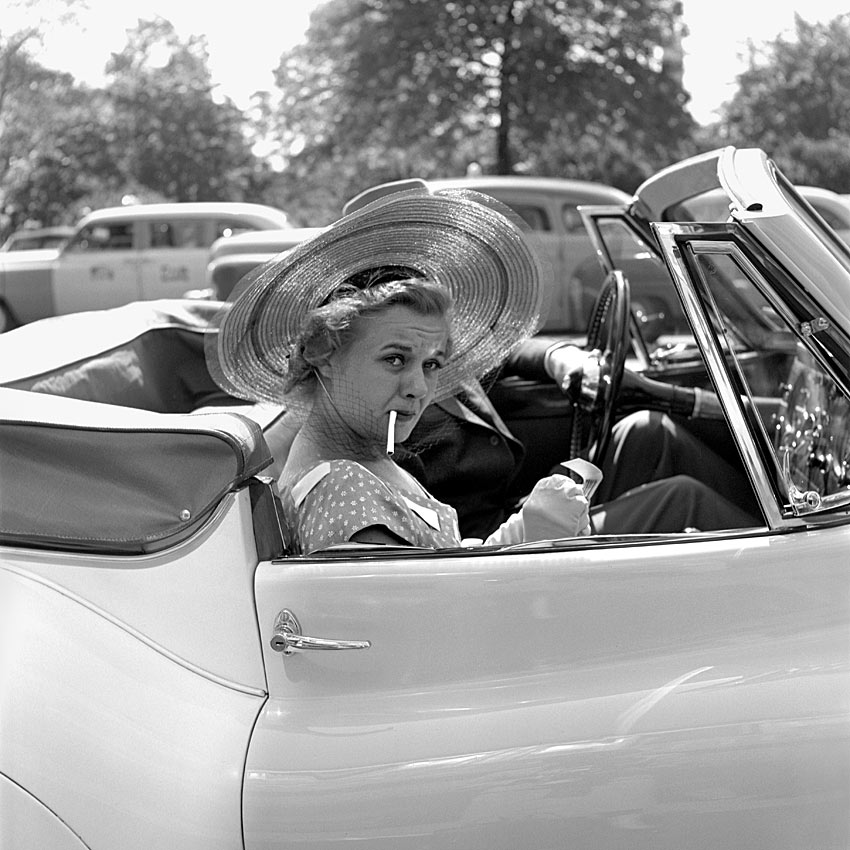
I’m need to put a cluster of Vivian Maier photographs in my newly painted bathroom. Alas, the guy who owns these prints hasn’t leased out the rights to a cheap distributer yet. So, that means a little art-hacking from me.
How to art hack? You find an image on the computer. Drag it to the desktop. Then take the .jpg to Staples and have them make a print for you. Cheap and illegal — my favorite kind of projects.

 Apt. 11d
I’ve been debating whether to say something and I decided that I must – especially since you are paid for some of your online writing.
I have friends and colleagues who have had their writing, photography, and illustration stolen and used by others, including Anthropologies and JC Penney. I know – you’d be surprised how often individuals AND big companies troll artists sites and blogs looking for content to life. And then resell as their own.
And if any of us are looking for artwork, there are many wonderful illustrations and paintings to be found on easy and other sites at a relatively inexpensive cost.
Artists and makers and writers deserve to be paid for their work.
LikeLike
Thank you Sandra. I agree but could not come up with a way to phrase it without sounding hostile.
LikeLike
Another thank you from me for the exact same reason.
LikeLike
Yes!
LikeLike
Having your art stolen would be upsetting, but having it stolen by JC Penny would be adding insult to injury.
LikeLike
Very true!
Having it stolen by Anthropologie would be annoying, but it’s a compliment.
LikeLike
Imagine if this happened to you:
http://www.theguardian.com/media/2009/jun/11/smith-family-photo-czech-advertisement
LikeLike
That kind of thing seems fundamentally different from printing something to hang in your house.
LikeLike
It might be technically legal but why not support independent artists and promote that instead?
LikeLike
It’s highly possible my face is plastered on multiple billboards. As is when I’m pictured in the newspaper I’m always the last to know. The best are the “quotes” from the accompanying article. I like finding out I said, “The [XX region] has a long and illustrious history, and as a foreigner I am greatly desirous to learn more about its fascinating culture!” Mostly I’m just super impressed at how eloquent my Chinese sounds 😉
LikeLike
I heard that if you look like a distinguished white guy, people in China will hire you to stand there and look like a distinguished white guy.
LikeLike
I believe there’s a pretty good living to be made doing that as a Westerner in Japan.
One of my old Peace Corps colleagues did that–he had been an aspiring actor back in the US.
LikeLike
Yes, it is different. I joked in this post that printing out an image is illegal. Reproducing an image to put in an IKEA frame in your bathroom clearly falls under the Fair Use law.
LikeLike
You know what is illegal? Bloggers, like myself, who use images from newspapers and insert them into blog posts without permission. If anyone complained, I would take down the image immediately. Nobody every has complained. Because this blog is small potatoes. If I felt like it, I could argue that this blog is designed for “educational” purposes and take down the ads that bring in about $30 per month. Then I could use the image under the Fair Use exception. But I wouldn’t bother. If someone had an issue, I would remove an image.
LikeLike
I wholeheartedly support the idea that artists should be paid for their work. But, I also believe that media conglomerates success in working towards perpetual copyrights have undermined respect for copyrights even among those of us who believe that artists deserve to be paid for their work.
In this instance, Vivian Maier took her photos in the 1950’s and 60’s, 60-70 years ago. She died 3 years ago without a will and with no known heirs, and it appears with no identified living relatives. Her work has reached us through chance discoveries.
http://gapersblock.com/ac/2013/08/13/the-curious-case-of-vivian-maiers-copyright/
The copyright provenance of Vivian Maier’s works is unclear and complicated and the lack of clarity has made her work unavailable.
The fabulous civil rights documentary, “Eyes on the Prize” was unavailable for a number of years because of wrangling over copyright of the tidbits of songs, documents, clips that were used in the production:
http://www.washingtonpost.com/wp-dyn/articles/A14801-2005Jan16.html
But, in this age of perpetual copyrights and media conglomeration, copyright can hamper creativity and the free exchange of ideas and applying the principle that “artists should be paid for their work” to this instance of a dead artist with subsequent wrangling over the rights to her work by many other parties doesn’t raise my sympathies much. There would be no copyright issue for Maier’s work if the original copyright act ( 14 years, renewal for another 14) were in effect, or if applying the rules that were in force when she was producing the work (before the 1976 revision of the copyright act). It wasn’t until 1998 that these convoluted issues arose — having to struggle with the availability of work 70 years after the artist’s death.
http://www.arl.org/focus-areas/copyright-ip/2486-copyright-timeline#.U3DlTS9iYtk
I would be pretty unsympathetic to “art hacking” if someone was grabbing pictures of a living artist and printing them for their own use. I’m very unsympathetic to commercial interests doing the same. But that’s not what’s happening with Maier’s works.
LikeLike
Read more, at Duke’s website:
https://web.law.duke.edu/cspd/publicdomainday
“For the works that are still commercially available, the shrinking public domain increases costs to citizens and limits creative reuse. But at least those works are available. Unfortunately, much of our cultural heritage, perhaps the majority of the culture of the last 80 years, consists of orphan works. These are works that have no identifiable or locatable copyright holder. Though no one is benefiting from the copyright, they are unavailable: it is presumptively illegal to copy, redistribute, or publicly perform them.”
LikeLike
Yes. Copyright law went at little nuts because Disney.
LikeLike
PS: I’m citing US copyright laws — Canada’s rule seems to be 50 years after publication (though there are special instances).
LikeLike
I was speaking not specifically about Vivian (although there are apparently heirs – things are happening behind the scenes).
More in general to the idea that if you need art, why not support artists? There is a lot of affordable art being made.
And to the Anthros and West Elms and JC Penney (others too) it’s part of their biz model to appropriate designs and then leave it to the artist to track it down/complain/etc rather than negotiating a contract in the first place.
Also, just because it might technically fall under fair use, doesn’t necessarily make it the best choice.
LikeLike
“More in general to the idea that if you need art, why not support artists?”
Yes!
I’m in talks with a painter that was a family friend to do a painting for us (probably a small kitchen-themed still life). No money yet, but I want to get a painting out of him before his hands get too shaky. I’ve already somehow acquired several pieces of his from my grandma.
LikeLike
Her work was so amazing and so extensive. Just looked through the self portrait series. I wonder what it meant to her and what role it played in her life. Her story reminds me a little bit of the posts Laura wrote of Aunt Theresa (well, maybe Theresa wasn’t the artist that Vivian Maier was, and, I guess, as a nanny, she acquired little and produced a lot).
LikeLike
The recent documentary is worth a view. The Howard Greenberg Gallery in NYC had a show of her self portraits last fall that I saw. The best of her work is stunning.
As an aside, there’s a Joel Myerowitz show right now at the Howard Greenberg that I’ll see in a few weeks. My husband saw it last week and loved it.
LikeLike
Under current US copyright laws, my guess is that the copyright ruling on the gallery show would be quite legally involved, and, that there’s no clear answer on any greater legal clarity to hanging Maier’s works in a gallery as opposed to hanging them in Laura’s bathroom. One could also question the websites that make the work accessible to me. Maloof (and others) purchase of the negatives does not give them right to make copies or to the copyright.
Copyright issues raise my hackles when I fear that they can undermine creativity, and when I think that an honorable principle is being used to extend the octopus reach of the mouse ears. The Maier case is actually a good illustration of the issues, especially with respect to orphan works — works in which the copyright holder cannot be clearly established — for those works, as stated at the Duke site, knee-jerk application of aggressive copyright rules could prevent dissemination of the work itself.
(Though there might be greater legal clarity if the gallery show contained only prints — I’m guessing not, if it was concentrating on self portraits– which were purchased — one does have the right to display purchased prints on a wall).
LikeLike
I have an photograph in my kitchen that I purchased from an artist on Etsy. I also really like Vivian Maier. I’ve probably referred to her three or four times over the past couple of years. I think by talking about her on my blog, I am promoting an artist. She just happens to be a dead artist. I first looked for an image of hers that I could buy on a museum or poster shop. They don’t exist. The guy who bought her undeveloped film at an estate sale for $100 hasn’t released the images yet. So, whatever. Staples reproduction it is.
LikeLike
The similarity — that she didn’t have anyone to admire her while she lived and, after she died, it is only strangers who can admire or profit from her work (unknown heirs would still qualify as strangers, and aren’t going to get much of my copyright sympathy, kind of like Hebrew Universities right to control Einsteins image — they lost a case in NJ in 2010, though that’s about celebrities, and not copyright).
LikeLike
Do we want to base whether we respect copyright on how sympathetic someone is. I think Orson Scott Card has repulsive views. Does that make it ok to rip him off?
LikeLike
I don’t think the point has anything to do with how sympathetic someone is. The point is that a copyright is granted as an incentive to allow those who create to capture the rewards of their effort. But the copyright term has been extended so long that only the interests of corporate conglomerates and intermediary agencies are being served.
LikeLike
Yes. In this instance, in my opinion (and I am not a lawyer) there’s no convincing case of a valid copyright holder (should I have called it intellectual property sympathy?). In spite of my opposition to the current state of copyright law, I generally believe in following the law. Sympathy only comes into play when we’re talking about the morality of the action in the absence of clear legal guidance. Something might be legally permissible, and I might still think it’s wrong. But I don’t think that about accessing Maier’s works.
If relatives are eventually found, they may indeed have the right to enforce their copyright (though personally I’d find that legally permissible but somewhat morally corrupt, since their claim to the work would be an accident of biology).
Right now, Neither Maloof (2007 purchaser) nor Goldstein (2010 purchaser) have a clear right to the IP. My guess is that everyone is trying to keep this out of the courts, ’cause no one sees a way clear to winning. In some cases, one of them (or Slattery, another purchaser) has a physical print made by Maier while others have the negative. Goldstein sells fine art prints made from the negatives and arranges exhibitions. Maloof appears to sell books and arrange exhibitions. Slattery has only sold his physical prints. A collaborator of Goldstein’s wrote in NYTimes Lens, that in a visit to France (where some of the pictures were taken), Goldstein left a USB’s worth of images to the French villagers who are pictured in some of the photos. The legal questions here are a morass, but the morality of using the pictures doesn’t disturb me at all.
LikeLike
It does matter to me that we’re talking about Maier here — if, say, Laura wanted to print one of my pictures from my website and hang it her bathroom, I’d expect her to be honorable enough to ask permission first. I’d grant it, of course, but permission (and acknowledgement) would be nice. I don’t sell my work, so I wouldn’t lose money and, I wouldn’t tell her to go find another artist who does sell their work, because, I’d be presuming that she wanted my work for it’s own worth (rather than because it’s free, though there’s always a danger there, of undercutting the work of others).
In the case of Maier, it is the beauty of work that’s the attraction, and, unfortunately, there’s no way to ask her permission.
LikeLike
I write on this blog for two or three hours every day for free. People consume my words. For free. People reproduce excerpts (and occasionally entire passages) on their websites for free and without permission. Some of those websites are professional organizations. Sometimes I write for professional magazines. I am paid a nominal fee. My words are then reproduced on that professional magazine and then sold out to affiliates and other private companies. I sign a contract that I will receive no portion of those profits.
Tangental information.
LikeLike
A food photographer colleague found his work on a Czech hotel site. He regularly uses google image search to find thieves lifting his images. He shoots for MS, NYT, etc.
Although fair use can be grey, any time you borrow images you should ask permission. It’s also prudent to have a usage policy in place on your blog/portfolio re words and images.
Another artist pal had 23 blog posts stolen by a life coach over the past six months. This coach’s website comprises stolen writing from a number of colleagues/friends. She did shut it down once caught.
The really creepy thing is that some if these were personal stories about my friend’s family.
LikeLike
I agree with having a usage policy and clear contact information. My policy on my photography sites is Creative Commons Attribution-NonCommercial-ShareAlike: http://creativecommons.org/licenses/by-nc-sa/3.0/us/.
I think Laura would possibly want a more restrictive policy, and I think it’s a service to the reader to think through those issues and make the policies explicit.
LikeLike
Yep. If you’re not overweight and at all attractive, you can get D-list celebrity status as “the foreigner” if you choose to take it. If you speak Chinese, that goes up to C-list.
LikeLike
This was meant as a response to MH
LikeLike
But, are you successfully monetizing?
LikeLike
Me? Definitely not. Unless you count endless boring dinners with important local people.
LikeLike
Define “overweight”?
LikeLike
Less leniency than in the US. If you’re going for distinguished middle aged white man, you could probably get away with being a bit overweight. Depends on how you carry it. Broad shoulders would help.
LikeLike
I think I need U.S.-levels of leniency unless I was wearing a suit. You can’t tell in a traditional-cut suit.
LikeLike
Stupid hipsters and their tight clothing.
LikeLike
Do you mostly play villains?
LikeLike
From the Vivian Maier website faq’s in answer to the question “can I use Vivan Maier’s photos on my website”:
“We do permit the usage of a limited number of Vivian Maier photographs on personal websites and blogs if the photos are used to write about Vivian Maier and her work. You do however have to contact Martin Fuchs, the archive manager of the Maloof Collection first to obtain permission. The use of Vivian Maier photos on any commercial website or in commercial context is not permitted. Please contact Martin Fuchs for licensing inquiries”.
Most if not all professional photographers require permission implicitly or explicitly.
And I didn’t bring this topic up as a “gotcha” for Laura – just that we all have done similar things without necessarily thinking through either the legal or ethical/moral implications.
Artists/writers/photographers/actors/etc. deserve to be paid for their work.
LikeLike
Who is Martin Fuchs anyway, and why does he have the right to give permission on the use of Maier’s photographs?
Fuchs is the archive manager of the Maloof’s collection of Maier’s photographs. Goldstein also has a website with Maier’s photos. I’m guessing both Maloof & Goldstein are searching hard to buy the rights from any extant relatives, if they exist and can be documented. But, right now, the Maier photos are a classic example of the problems that arise with orphan works in the age of endless corporate copyright.
I don’t see this as a gotcha topic for Laura, and my eyebrows were raised at the concept of “Art hacking”, too, if it meant taking the work of artists without their permission. But, the Maier story is much more complicated.
LikeLike
Not a gotcha at all. I already stated that I know that it is illegal to use a Maier photograph on my blog without permission. I do it anyway. So do about 1 billion other bloggers. It is, however, not illegal to reproduce an image for personal use, in low resolution, for non-commercial use. It’s “fair use.” That rule applies to all artists, not just Maier. Really.
LikeLike
I also like to take existing photographs and images, some of which are copyrighted, and fool around with them on photoshop until they are really different. If I make enough changes, then it becomes my own property. I can sell it and make a profit.
LikeLike
Yes – that is legal and it’s also another grey area when deciding the line between copying and a new work.
BJ – the Maier story IS complicated. Like I noted above, behind the scenes some relatives have been located too. I find even the documentary a bit troublesome. I saw it at TIFF last fall and Maloof & his filmmaker did a Q&A.
The doc feels a bit icky and intrusive in pastors, speculating about Maier’s mental health. A few interviews seemed more about the interviewees rather than Maier.
This just reminded me of how in general, so many assume that just because the words and images are on the ‘net, that they can be freely used.
LikeLike
And you are a great writer – who knows where your work has been plagiarized and monetized.
LikeLike
The law is kind of unclear on that topic — of derivative works — one of the reasons I try to be big defender of the public domain, when work really does become available for re-mixing without worry of consequences. Examples of derivative works about which there has been litigation include the Shepard Fairey poster of Obama (based on a photograph by Mannie Garcia of the AP), The Wind Done Gone (a re-telling of Gone with the Wind, from Mammy’s point of view), and a book about Holden Caulfield grown up, and artwork based on origami crease patterns. There have been lawsuits about all of those. Fairey settled (but then admitted to fraud during the case); Alice Randall won, after appeals in the WInd Done Gone case. The author of the Caulfield book lost, and the book was withdrawn from American sales. The origami case was settled. So derivative works can be a risk, a risk that would be resolved by more firmly limiting the length of copyright. Then, you could just wait until the work was old enough and use it freely. But, in the US, nothing has gone into the public domain for 10+ years because of a retroactive extension of the copyright law.
Now, unless you try to officially publish your work in some way (say, for the cover of the book you’re going to write) or a work takes off (like the Fairey poster), you’re not likely to raise anyone’s ire. Well unless the original artist finds you and gets offended (as happened with Lang when he found his crease patterns being used by Sarah Morris: http://www.langorigami.com/copyright/sarah_morris_copyright_infringement.php).
OK, I’m going to stop going on and on. Feel feel to remind me if I can’t resist.
LikeLike
(wrote a long comment that was eaten. Arg. Happens to me, too.)
Have my words been used on a Chinese Viagra website seeking to boost its SEO with random content? Yes. Do I care? No. My biggest problem isn’t that random people and websites are using my words without my permission. My biggest problem is that I can’t make a living legitimately by writing. There is no money out there. It’s not because of a few random Chinese Viagra websites. Nobody (except for a few outliers) is making a living with words or art. Not even my friends who have landed book deals. I write, because I have to.
Just keeping it real…. Ads on this blog = $30 per month. Articles for high end, professional journals (2 or 3 days of writing and social media promotion) = $100-300. Amazon hustling around the holidays = $200-300.
It would be nice if writers and artists could eek out a middle class salary from their work. And I want a pony.
LikeLike