
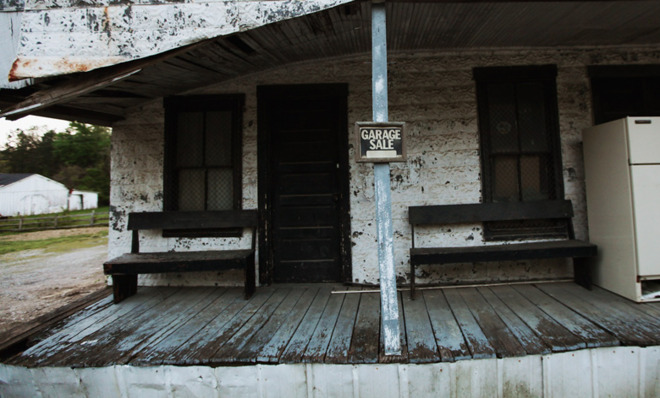
 The National Review ran a remarkable article about poverty in Applachia last December, which was recently reprinted at The Week.
The author, Kevin Williamson, writes about the use of food stamps for black market Pepsi.
It works like this: Once a month, the debit-card accounts of those receiving what we still call food stamps are credited with a few hundred dollars — about $500 for a family of four, on average — which are immediately converted into a unit of exchange, in this case cases of soda. On the day when accounts are credited, local establishments accepting EBT cardsare swamped with locals using their public benefits to buy cases and cases — reports put the number at 30 to 40 cases for some buyers — of soda. Those cases of soda then either go on to another retailer, who buys them at 50 cents on the dollar, in effect laundering those $500 in monthly benefits into $250 in cash — a considerably worse rate than your typical organized-crime money launderer offers — or else they go into the local black-market economy, where they can be used as currency in such ventures as the dealing of unauthorized prescription painkillers — by “pillbillies,” as they are known at the sympathetic establishments in Florida that do so much business with Kentucky and West Virginia that the relevant interstate bus service is nicknamed the “OxyContin Express.”
He describes a grim and pathetic poverty without any redeeming virtues of hard-work, thrift, and grit.
This isn’t the Kentucky of Elmore Leonard’s imagination, and there is nothing romantic about it. These are no fiercely independent remnants of the old America clinging to their homes and their traditional ways. This is the land of families of four clutching $40 worth of lotto scratchers and crushing the springs on their beaten-down Camry while getting dinner from a Phillips 66 station.
Williamson is pretty harsh on the food stamp program and other government benefits, because he believes that they are supporting bad habits. But he also says that this poverty isn’t caused by “bad values.” In this area of Eastern Kentucky, people stay married and aren’t making too many teenager mothers.
Read it. It’s good to read both points of view. And there’s some nice writing in there.

 Apt. 11d
That was an interesting article, with no overt political thesis. The lesson I came away with was:
Most of the people in the world are and always have been poor. Sometimes formerly rich areas are impoverished by war, civil strife or other forms of social pathology, or possibly by exhaustion of natural resources, but that isn’t what happened in Appalachia. It’s just that nothing ever happened to make the area rich. There’s been a little bit of coal mining, and factories here and there, but fundamentally, a bunch of European peasants moved in 300 years ago, and they’re still there.
I don’t know if other people came away with the same lesson.
LikeLike
The poor you will always have with you. The destruction of the middle class is completely optional.
Anyway, I’m descended entirely from European peasants and fail to see why ancestry matters that much. I view West Virginia’s level of poverty not just as a moral failure, but as a practical danger to myself. Poor people don’t worry about the environment and are less able to force businesses to follow regulations even they exist. It was only a few dozen miles of hills that separated the toxic waste from the giant “Freedom Industries” spill from washing right by where I live.
LikeLike
I don’t know that the “destruction of the middle class” meme has any relevance to Appalachia. The cited article doesn’t have any data bearing very directly on that point. However, the article does indicate that (i) no one gets rich in Appalachia (the ambitious young people leave) but (ii) levels of social pathology (crime, drugs, single-parent families, etc.) are low. So from that limited evidence I would expect the income distribution to be fairly equal.
LikeLike
It was very interesting to see what American ingenuity has devolved into–it reminds me a lot of the various post-Soviet Russian scams I’ve heard of. What a waste of brains and energy.
My sister spends a lot of time in our home town, and the last time we visited, she was telling me about food stamp scams that she has seen or heard of. As I recall, she overheard someone on the bus discussing how he was going to pay his car or truck payment by handing over his EBT card to somebody (presumably at a substantial discount). She also mentioned that she’s seen at least one person (at a gas station?) attempting to use an EBT card that they didn’t have the PIN number for, and they were calling their friend to tell them the PIN number so they can use it.
And then outside the world of outright fraud, there’s my parents’ former neighbor, who somehow managed to qualify for food stamps, which was very helpful to his chosen career of sponging off his live-in girlfriend, working as little as he could manage (it wasn’t that there wasn’t work–he didn’t want it and his work ethic stank), and dodging child support for the kid he fathered at 16. (Happy ending–the live-in girlfriend eventually kicked him out. Less happy ending–she immediately moved in with a disability-collecting medical pot grower twice her age.)
LikeLike
How many people are really defrauding welfare and food stamps program? Are these stories representative of a handful of jerks or is everybody doing it? I feel like I need to know those numbers.
Let’s just assume that this fraud is widespread…. If adults are living in shacks doing oxy and eating gas station nachos with their welfare checks, that’s annoying, but not horrible. If their children are hungry, because the parents are assholes, then that makes my head explode. One solution is to expand food programs through schools. They have a version of that in NYC, not sure how it is working.
In a two year break in grad school, I taught special ed in the South Bronx. On Monday morning, we brought boxes of cereal from home and fed the kids in our classroom before starting work. They were hungry. Extremely disabled kids in wheelchairs + hunger = Head Explosion Time
LikeLike
How many people are really defrauding welfare and food stamps program?
Not many. This type of trafficking is about 1.3% of the program and the overall fraud rate is 4%.
LikeLike
D’oh.
LikeLike
The answer is that no one knows. This is what statisticians call a “dark number”–one that’s inherently very hard to collect. Numbers based on prosecutions are likely to account for only a tiny fraction of the fraud, since the sort of fraud that Williamson describes–buying goods and then selling them at a discount–is virtually impossible to detect. It’s all anecdata. My answer is “significant enough that all the folks I know in these communities can describe a bevy of standard scams. How much of dollar outlay does it account for? No way to tell. I doubt we’ll ever know.
LikeLike
Yes, in dollar numbers, for example, I’m pretty confident that the amount of wasted taxpayer dollars in defense related enterprises (i.e. scams, kickbacks, bribery) is larger than the amount in SNAP fraud.
http://www.sanders.senate.gov/newsroom/press-releases/fraudulent-defense-contractors-paid-1-trillion
After all, the SNAP folks do need to eat, which, one imagines might bound their fraudulent use of the cards to some level. It’s not altogether clear what the personal limit on defense fraud would be (unless they get caught)
LikeLike
Everybody knows a bevy of standard scams. If everybody who told stories about how to cheat an insurance company was talking from personal experience, all those companies would be broke.
LikeLike
Answer. Less than 1% http://www.nytimes.com/2013/12/19/us/food-stamp-fraud-in-the-underground-economy.html?pagewanted=1&_r=0
LikeLike
Yes, fraud is only a problem if it becomes big enough that it is undermining the program (which does happen). I’m far more concerned about the level of fraud in medicare/medicaid admissions than in food stamps (and I’d like to see a comparison of the numbers).
Also, this particular fraud could be mitigated by regulatory oversight (iwhich I approve of).
Yes, the hungry children make my head explode, too. And, I do think that providing food at schools and other programs where the children themselves are is a good way of addressing the issue. Would be interesting to see more official policy/data on how effectively feeding children at schools work. Feeding the children is also a benefit to pre-school programs/after school programs/summer programs/longer school hours.
LikeLike
Making sure that kids are well fed at school is a “pay now or pay later” proposition. It’s difficult to learn if you are hungry.
The cost of providing a breakfast is tiny compared to later costs for other social programs.
LikeLike
AND IT’S NOT LIKE FREE BREAKFAST AND LUNCH IS A NEW, UNTRIED PROGRAM. Hell, I had free breakfast and lunch in the 1960s at a public school in Denver. My kids’ public elementary school provided free breakfast to all students (although not everybody qualified for free lunch) in the mid-to-late 1990s. Add free lunches in public parks in the summer (a program my siblings and I benefited from in the 1970s) and you’ve done a lot to help kids at relatively low cost.
LikeLike
BTW, that would work out to 100 billion/year in defense fraud (measured in discovered fraud).
LikeLike
But! But! What about all the poor hungry people using food stamps to pay their car loans and buy pain pills? Aren’t those the real villains?
China has a new campaign to prosecute “tigers and flies” (both high and low level officials) when it comes to corruption. In the US we seem to care more about stamping out the dust mites.
LikeLike
Are you serious? A subsidiary of Northrop Grumman was accused of a fraud of $62 million once so Bernie Sanders says all sales by Northrop Grumman over 10 years can be added up and we will call it all fraud? Even though the amount itself was about 1/2 of one percent of one years sales? That is absurd. A+ to Bernie Sanders in propaganda though.
LikeLike
The story about the shifting around of canned soda with intent to defraud reminds me of Goldman shifting around aluminum with intent to defraud. That was $5 billion right there. I have no idea what Northrop Grumman did or didn’t do, but the idea that U.S. spends way more effort policing nickels while letting the big guys run the board with impunity seem pretty much irrefutable.
LikeLike
To be fair to Sanders, it was me who translated his number into 100 billion of defense fraud (and, I will admit, that rewording is inaccurate). The press release accurately states that it is 1 trillion was paid to fraudulent defense contractors (not that all those payments were fraudulent).
I also like the example of moving around of aluminum: http://www.nytimes.com/2013/07/21/business/a-shuffle-of-aluminum-but-to-banks-pure-gold.html?_r=0 as a fraud — but it was consumers rather than taxpayers who defrauded that way.
The bottom line is that the fraud in SNAP is penny ante as far as I’m concerned and doesn’t really change my opinion of the program. Where I do get concerned is if enough of the money is diverted away so that children aren’t getting fed — focusing on children because presumably the hypothetical guy who is using the money for his car payments is somehow eating, too. That’s a reason to have programs that feed as many of the hungry children as possible, with real food, that can’t be exchanged into something else (school lunches, preschool lunches, summer programs, . . . .).
LikeLike