
In my last Atlantic article, I began drawing a link between the dropout rate, transfers, and student loan debt. I am going to continue to write about that.
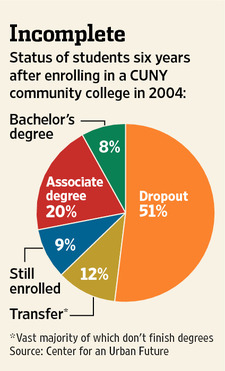
A recent WSJ article points to a new study that found that 51% of students in CUNY community colleges drop out of school.
About 51% of the city's community college students leave school before earning an associates or bachelor's degree within six years of enrollment, the report said. Another 12% transfer out of the community college system, but there are no data on how many finish school.
Only 28% get associates or bachelor's degrees within six years…

 Apt. 11d
How about the link between dropout rates and students unprepared to do college-level work?
Too many students arrive at community colleges without having learned basic reading and math concepts. Most must take developmental courses that provide no credit toward a degree but still cost as much as college-level courses.
Community college students’ “chances of dropout are far higher than students who test into college-level courses immediately,” the report said….
A CUNY spokesman said in a statement that the system had made efforts to boost graduation rates. But he noted that “almost four out of every five freshman who arrive at its community colleges with a high school degree require remediation in reading, writing or mathematics.”
Here’s how another state is dealing with the issue: Ohio to stop state funding for college remedial courses
LikeLike
Joanne Jacobs is very insistent on remedial classes being a black hole for college students (I think she’d like to see those students go straight into ordinary courses), but that sounds very questionable to me. CCs take in just about everybody. A close relative who teaches remedial CC classes says that they have a lot of extremely marginal students. He says a number of those students would find holding down a job as a hotel maid rather a stretch. CC classes give those students a place to go and something to do.
I think that students (not the extremely margina ones) can benefit immensely from CC classes without necessarily going for a degree. If you need particular skills, you may just need a class or two. There may be the greatest return on investment for taking just a few classes (getting over a math phobia, being able to write a literate email, etc). I don’t think non-completion of degrees is necessarily a tragedy at the CC level.
LikeLike
I find it interesting that society spends much time, effort and money getting kids ready for the SAT or ACT, but little to no time letting community college students know that they’ll be tested for placement upon their arrival at college. I’ve got to wonder how many students are actually prepared for the placement tests. Do they realize the implications of the test? For many remedial courses equal more debt without any credit. Harsh lesson.
LikeLike
I don’t think non-completion of degrees is necessarily a tragedy at the CC level.
I agree, but non-completion paired with significant student loans probably is.
LikeLike
I’m not exactly sure why this is an article about CUNY. All schools are required to report their 6-year graduation rate. The average for all 2-year colleges in 20.2%.
http://collegecompletion.chronicle.com/
Why are we focusing on CUNY, as if it is significantly different from other Community Colleges?
LikeLike
I agree with Amy here–you have to consider students’ intent/purpose in going to community college. A degree may not be the goal.
Another thing to consider is what is meant by remedial. I honestly do not know if you all agree on what skills a college-level student needs. We all know who the weakest of the weak are; they’re obvious. But there are a whole lot of in-between students. Sometimes I get students who don’t even know how to introduce an essay or write in paragraphs. OK, they’re easy to identify as remedial. But what about the ones who can’t use a comma to save their lives, but the words are all pretty decent and in a logical order? What about the ones who don’t know where to put the letter s. (Typical sentence from this latter category: “It look like the main points of the essay is to persuade the audiences.”)
Sometimes, usually a week or so before the end of the term, I become convinced that my students all need remedial work and I am the worst and most ineffective teacher ever. At those times, I can (and sad to say sometimes do) pull any sentence from any essay and show friends, and they will agree that they do not know how such a student could have possibly gotten into a college did they sleep through high school what were the admissions people thinking omgwtfbbq. And it’s easy, if you’re not the one teaching, to nod knowingly about the students who just shouldn’t be in college and to pontificate on the wrongness of colleges that admit students who so obviously shouldn’t be there.
But then some of us teach them. And what do we see? We see people trying to move on in their lives, trying to “make something” of themselves. They’re trying to live their dreams, or their mothers’ dreams, or feed their kids or be a role model for their kids.
Maybe going to community college (or any college) is kind of like having a kid. You’re never ready to have a kid. There’s not some shining moment where you are “ready for parenthood.” Some things you’re really going to screw up, and sometimes you’ll be lazy, and sometimes you’ll party a little too much. And it will all cost a hell of a lot of money. But you just go ahead and do it anyway and try to make the best you can out of the experience.
LikeLike
“I agree, but non-completion paired with significant student loans probably is.”
You have to work at getting huge community college loans. Where my relatives teach (WA state), students are essentially being paid to go to school, so some of the students can’t really afford to not go to CC. I’m not sure how the system works exactly (Pell Grants or some other similar program?), but there’s a tendency to just show up for the first few classes or very sporadically.
LikeLike
Absolutely brillant sentiment Wendy.
LikeLike
I am an undergrad at a “fancy” New England private liberal arts institution. I am a dime-a-dozen student considering the region, yet I like fancy. I am also a CC grad. I will be a part of the 28% in May 2013. And I still have no idea how to use a comma.
I went back to school because I became a parent, and I had virtually no idea what I was doing. I sat in remedial Math and English, and judging by the most recent comments on a draft of my thesis I should probably go back to that English class.
All that happy-fancy-stuff aside, financial aid should be limited. I watched students at CC register for the same classes over and over again. I am not suggesting CC students should not be able to borrow, but it should be on a system that limits the amount of attempts aid is given for. Also loan “refund” or funding overage should be comparable to the amount of classes taken. If a student has a full time course load, they depend on loans to survive. If a student is taking a part -time course load then ideally they should be able to work a bit to help their cost of living.
Lastly, to all you CC Profs, keep teaching. One day I may learn how to use a comma, and I will have you all to thank.
LikeLike
Fionnuala:
I’m a college professor and I still struggle with where to use commas. However, I now have the resources to have an editor look over my work. While grammar is clearly important, I’d be more concerned about students who don’t develop the necessary skills in analysis and critical thinking. That’s a much deeper problem.
I like what you said here about the number of retakes of the same class a student might be allowed. I see this as well — students who will fail my required class and then immediately sign up to take it again. I often meet with the students and ask them “Let’s talk about why you didn’t pass last time.” And if we determine that it’s because they didn’t devote sufficient time to the course then I ask them to show me a schedule indicating where and how they are going to find the time to pass the course this semester. If they failed because of writing issues I ask to see a note from the Writing Center with a plan to fix their writing before the start of the next semester. I am concerned by students who somehow or other think that if they keep taking the course then eventually they will pass — as if they’re buying lottery tickets or something. (But maybe they are buying lottery tickets, in the sense that they’re gambling on getting a different, easier instructor the next iteration of the course.) It is frightening, however, how divorced the financial aid proceedings at the university are from the teaching that goes on. Individual instructors can identify the person who has been at the university for six years and probably will never graduate but there’s no actual avenue for soliciting that input from faculty nor is there any avenue for providing it.
LikeLike
“It is frightening, however, how divorced the financial aid proceedings at the university are from the teaching that goes on. Individual instructors can identify the person who has been at the university for six years and probably will never graduate but there’s no actual avenue for soliciting that input from faculty nor is there any avenue for providing it.”
THAT!!!!
This article focused on CUNY, because the WSJ picked up a report that focused on CUNY.
Steve was a community college prof at a CUNY school for years and so are many of my friends. The community colleges in the city are acting as high schools. They are providing basic instruction that should have happened earlier. This is not part of the original mission of community colleges. Steve taught a geography class for several terms and his students struggled with identifying major bodies of water and continents. Stuff that Ian knows. A few students could not distinguish between water and land and would label Asia as the Pacific Ocean.
LikeLike
“They are providing basic instruction that should have happened earlier.”
The instruction happened. The learning didn’t. There are a million reasons why that could have happened.
Btw, I have an e-mail in my work inbox right now from a student who needed a B in order to keep his financial aid. I gave him a gift C+. What do I do with him? He’s a great student in that he came to class, he participated a lot, and he did all the assignments. But he just doesn’t get literary interpretation, no matter how simple I made it for him. He’s not as skilled as most of the class, and his writing skills are very weak. What is to be gained this point from denying him a B? These are huge ethical questions.
This is just one class out of 40 he will be taking. Why do I as an individual faculty member have to shoulder the burden for the other 39 courses? I don’t have a clue what’s going on. Maybe he’s a math genius. Maybe he has an entrepreneurial spirit that comes alive in his marketing class. Maybe he’s just going to school to get a credential so he can be a security guard and have a steady job and raise a family. Does it really matter that she can’t seem to see the difference between symbolism and metaphor? That when she writes about A Raisin in the Sun in an in-class exam, her writing is full of grammar errors?
LikeLike
“I often meet with the students and ask them “Let’s talk about why you didn’t pass last time.”
Bravo, Louisa!
From my relatives’ war stories, there are immense differences between the different CC students. Some are in it for the money they get to go to school. A lot of them want to be nurses (and my relative does God’s work when he keeps the bad ones from achieving that goal). Some of them didn’t have the chance to take full advantage of the K-12 system for whatever reason, or didn’t appreciate the opportunity at the time. My relatives’ prize students are two bright 30-ish women who are probably autistic and came from a chaotic home, as well as a 20-something whose high school motto was “D is for diploma!” but who has since gotten her act together and is working very, very hard. Those last three women are the reason why the CC system is worthwhile. And then there are people like the guy who scheduled a non-emergency vet appointment during his math class, obviously regarding it as no different from K-12, where any time you have an excuse to get out of class, you do it.
LikeLike
The instruction happened. The learning didn’t.
That’s a big assumption. There’s a lot of “non-instruction” going on in public schools. I’ve seen it first hand, with “college-track” high school students being assigned posters and collages instead of essays.
LikeLike