
In yesterday's New York Times, Stephanie Coonz wrote a devastating rebuttal to Hanna Rosin's book, The End of Men: And the Rise of Women
. She looked at a variety of statistics to show that men aren't doing as badly as Rosin claims. (Another interesting rebuttal here.)
Coonz says that some of the data that Rosin and others use to show that women are now dominating in the workforce has been used inappropriately. For example, the number of women who outearn their husbands has been widely misstated. I've read multiple media reports that state that 40% of women earn the same or more than their husbands. However, if you include in those numbers all families, even those where women does not work at all, then that number shrinks down to 20%
Of course, Coonz does a little cherry picking of her own. She uses this chart to show that women are paid less than men, presumably because of sexism in the workforce.
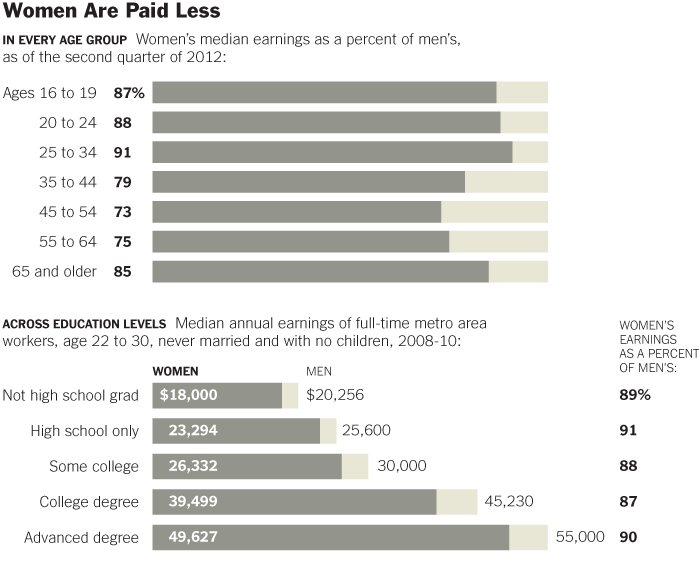
In many cases, women's pay is depressed, because they take off time for the workforce to raise children, so the second chart which compares single, childless women with their male counterparts is better. However, women may chose less competitive jobs (pediatrician rather than brain surgeon), because they plan to have children sometime in the future. Single women may be making long term decisions that depress their pay. Even those who never plan on having kids may be choosing life style over income.
I'm not weighing in on the gender wars at this point. I'm more peeved at how statistics can be used irresponsibly by the media.

 Apt. 11d
Mnnn.
I liked the article a lot and I agree that “the media” (whatever that is) often gets it wrong – editors are just as prone to fads, in part because fads pay the bills, as anyone.
But also because time and space are limited, and telling a story is about telling a story. The media cherry picks because _that is the news that day_.
When “the media” has tried to present balanced views like “this shows this; that shows that; it’s hard to know what the reality is and it probably doesn’t say a lot about your life anyway” they have traditionally gone out of business. For the full story you have to continue to read on, in a way, and keep going with the discussion over time.
This was always true – I do think media has been going through a huge resource crisis (the need to be first with a story vs. shrinking budgets) but one reason we think the media might have been more right in the past is that it is the rightness that has stuck around while all the daily, “hey Rosin has a book and it says this!” uncritical stuff just vanished into microfiche.
That’s what academia is for, in a way; the less catchy info.
But it is the media that published Coontz too, and so on. Give it some time.
LikeLike