
This will be a quickie post that rams together several thoughts that really should be separated into several separate posts. But I have to start the monumental task of cleaning out an old lady's house. The tyranny of stuff.
Yesterday, a good discussion broke out in our comment section about this widely distributed map, which shows which the states that have the highest number of people who don't pay income tax.
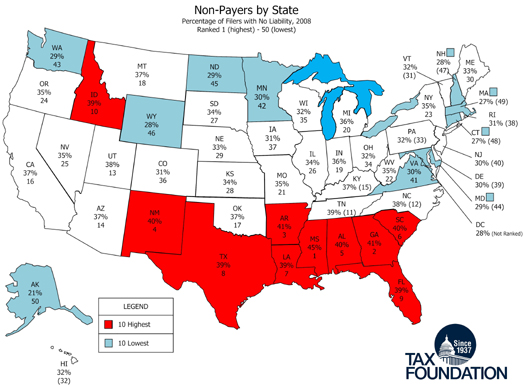
The point of that map (which has been widely circulated) is to show that much of Romney's base is receiving government benefits of some form and that his comment about people feeling entitled to benefits must have offended them.
The Republican party is a weird coalition of social conservatives, many of whom are not wealthy, and wealthy country club types. Right now, Democrats are trying to drive a wedge between those two groups and hope to depress the social conservative vote in November. That's just smart politics.
Artemesia wrote a really smart comment that helps to explain why there is resentment against the undeserving poor and why it might be stronger in the South.
But I grew up in a red state. And I think we need to consider a different interpretation to the Moocher States map: when voting citizens see others, especially people close to them – their neighbors, their children – using government services instead of working, they are more likely to vote against candidates in favor of those social programs that (in their view) encourage that behavior. There are many people who badly need the safety net – but there are also people who behave irresponsibly – or at least are perceived to – because the safety net is there.
In my blue state, very few middle-class kids are getting pregnant out of wedlock or having children before they've gone through college. People on welfare (this is based on my work for a state agency, otherwise I would know NONE) are chronically ill or can't speak the language or have no education and limited intellectual potential.
In my red home state, there are more white babies born out of wedlock than to married couples. People with middle class upbringings I graduated with are on disability but in bowling leagues. And this is who voters in those states see – not those who truly need the safety net.
We can't solve this unless we understand.
Look, the economy sucks. All of us are either working too much or aren't working as much as we would like. Much of America is either exhausted or depressed. That causes people to look at their neighbors with suspicion and bitterness.
In my old neighborhood of contractors and teachers, I would see the guys out mowing their lawns at 4 and not see my tired hubby trudging down the block from the bus stop for another 4 hours. Some days, not my best days, I would feel resentful. And they would look at me getting my kids to the bus stop in my jogging pants and they would hate me for not going to work. They had no idea of everything I was doing after the school bus left. They would see my husband in his tie and his iPod and they would assume that we were rich bastards. We all know people who we think have gotten professional rewards that really should have gone to us. Resentment and bitterness is not isolated in the South. It's everywhere right now.
However, it's irresponsible to use that bitterness and resentment, which is based on ignorance and hurt, and use it for political gain.
It is also politically stupid to divide America in two groups of government moochers and hard workers, because nearly all of us are government moochers of one kind or another.
I'm hearing a lot of people question Romney's IQ right now.
And here's where I take a weird digression, because I am rather rushed at the moment. The teachers' strike in Chicago. I haven't posted on it, because I don't have any unique thoughts on it at the moment. I do think it's interesting that the key issue of the strike revolves around merit pay. Who deserves a raise? People who work harder or people who do the time? How do we measure hard work?
I really should post more links to the Chicago strike. In the meantime, I just read a blog post from a conservative education policy writer, Jay P. Greene. I don't agree with many of his points, but it was still interesting. Jay makes a distinction between true merit pay and false merit pay. Curious what you guys think about it.


I know my personal resentment factor increases exponentially when I’m tired. How do I know this? I had two kids and spent roughly 3 years of my life angry at my husband for [insert ignored chore here].
My point is that this kind of thing is not necessarily rational; it goes to the exhaustion and stress of the person doing the accusing. And so I’m not sure there’s any argument focusing a better definition of “deserving” that will really get to the heart of the matter. When my kids were young what I really needed was a nap, not a husband who magically read my mind and proactively did the laundry. Not sure what the equivalent is in the political sphere, but it would be great if we could focus on *that* instead.
LikeLike
I really am a seething mass of personal resentments, but thanks to education, I know how to express myself without making such resentments so obvious. Thanks college.
LikeLike
All of this. When I think of people receiving welfare and foodstamps, I think of my mother who did drugs and didn’t always feed us, and all her friends who scammed government benefits so they could get high all day and work as little as possible, usually for under-the-table pay or barter, or just steal other people’s stuff and sell it. I don’t think of under- or unemployed people needing extra food for their children, or medical care. That’s my responsibility to change how I think about it–but it’s also true that what I experienced happens.
LikeLike
I completely understand. My sister-in-law is a visiting next week. She seems to go through life like “Baby Stewie” from Who Framed Roger Rabbit, giddily walking from one near miss to the next, never noticing how close she came to disaster as the knives whiz by, and always coming out smelling like roses. Never held down a steady job, but won the stock-option lottery several times when she had them briefly . . . failed marriages but always a profitable divorce settlement. The last one required her to stay on her ex-es health care for a long period, followed by COBRA. I remember thinking, “Well, that’ll run out soon, and then she’ll HAVE to get a job just so she can have health insurance!” Damn you, Affordable Care Act! She’s going to qualify for free or almost-free health care!
And then she complains that we’re never free to spend time with her. (Because we are working, dammit!)
But, I tell myself repeatedly, it’s probably not worth it to make millions lose their health insurance just so I can force my sister-in-law to get a job. (Oh, but the scales are so close . . .)
LikeLike
Well, I found the Jay Greene piece helpful in thinking about Michelle Rhee and the Gates Foundation. He (Greene) is absolutely right about merit pay. Doing it mechanistically appeals, though, because it seems to factor out human judgment. It would be great to have principals deciding who to hire and fire, and what raises to give and deny, if they were selected for and trained in their capacity to discern the quality of instruction and extent of learning…. But they’re not, by and large, and everyone knows this, including parents, teachers, Michelle Rhee and Gates. Its just nothing to do with the job. So there is a HUGE transition problem. I guess Greene’s bet is that the spread of Charters increases the likelihood of such people becoming and remaining principals; slowly solving the transition problem. Good luck!
No, really, its a good and insightful piece. Thanks for linking to it.
LikeLike
“But, I tell myself repeatedly, it’s probably not worth it to make millions lose their health insurance just so I can force my sister-in-law to get a job. (Oh, but the scales are so close . . .)”
Hah, all you order muppets frustrated by the chaos muppets. No one would look at me and think I’m irresponsible, but in my heart I’m a chaos muppet. I’ve always been a serious sucker for people who say they forgot/lost their wallets/keys/bus ticket and need $5 bucks for the trip home. My thinking brain prevents me from giving money these days, but I used to do it under the assumption that some of those folks might be telling the truth (you know, like 10% or something). But, I’ve come to recognize that the probability is probably closer to infinitesimal than 10.
In my mind, that’s where the welfare equation falls. I know that there will be some “undeserving” folk (at least ones I think are undeserving; someone else might classify the sister-in-law who manages good divorce settlements differently). What my support depends on is percents.
(And, with my growing years, I’ve come to recognize addiction and mental illness as illnesses, not choices).
LikeLike
The difference between different moochers, if we concede for the moment to the moral stupidity embedded inside that word, is that some of us feel like we use and control and have access to government and some of us don’t. Of those that don’t, some choose to use something of their identity: race, culture, place, gender–to forget their own dependency and imagine it wholly to belong to someone else. Lots of folks in my wife’s hometown that we’ve talked to over the years see it that way: everything they get from government (state and federal) is owed to them, even when the benefits they’re receiving vastly outpace what they paid in as workers, because they’re the real Americans. Everything everyone else is getting is parasitism. But that’s a sentiment born of their entirely accurate feeling that they’re essentially powerless in the economy of the last twenty years: too elderly, too unskilled, too stuck in gerrymandered districts, too enmeshed in endemic corruption, too unfamiliar with the world that has arisen around them, too abandoned by children who’ve gone to better places, to even begin to give an honest accounting of their situation. So when Romney says, “Hey, you, in the 47%,” they don’t think he’s talking to them, even though by any truthful accounting, he is. They think he means the hard-working Latinos who’ve moved in in the last generation (who very likely pay both payroll AND income taxes) or the small community of African-Americans who are more or less in the same boat as the older Irish and Italian-American neighborhoods and have been all along. Or, against all logic, they think Romney means middle to upper-middle class educated professionals somewhere else, the people who are providing what’s left of the revenue stream that lets the federal and state governments keep the resentniks afloat in this increasingly uncaring world.
If the state governments of the US had to go alone for a year fiscally, most would make Greece look like Daddy Warbucks–and most of all the states that are going to go Republican no matter who the nominee is. Until something of that reality sinks in, we’re all in a sinking lifeboat, surrounded by people who keep poking more holes in the bottom of the raft.
LikeLike
I am always interested to see what my Conservative “Facebook Friends” are talking about, and yesterday it was the Veterans Jobs Bill that was voted down by Republicans in the Senate on a party line vote.
“The legislation would have funded a proposal by President Barack Obama to create a veterans jobs corps, spending $1 billion on programs and grants to put former servicemembers to work as police officers, emergency response personnel and park rangers.”
They seem confused why the Republicans are lining up against veterans. (Military Good!) It does not occur to them that unemployed veterans are part of the “47%” and that helping them get jobs as police officers is promoting public sector workers.
LikeLike
As a mostly-Canadian I find the whole discussion interesting and we definitely have it too around “welfare queens” and all the rest of it.
But my position is that it’s okay to, in a basic way, feed and house and attempt to educate people even if they’re crappy lazy lousy people. Most people aren’t crappy lazy and lousy, and don’t want to stay in that position and if there are some who could do better but are content to live in a rooming house and run out of food at the end of every month and my tax rate as a result means my family can’t afford to go to Paris but once every 5 years then okay, I can live with that. I mean I could try for a better paying job I hate too.
I realize this is anathema to some people. But for me right now our taxes are not skyrocketing and so far things seem relatively balanced, so I don’t feel like I need to get high and mighty about the percentage of people who technically could go work mopping floors and don’t. I also think society kind of has to come to terms with how much effort you are going to put in to catch the last 0.03% of scammers. I am guessing it would cost more to assess everyone’s “real” illness/ability to work a crap job/etc. than it is to keep welfare at the point where it will sustain someone’s body but isn’t very much fun.
But I say that from a country that, while carrying some debt and in a deficit position, isn’t trapped in a huge debt spiral. Yet. Until our largest trading partner sinks. If the US can’t raise tax rates or change expenses it is not going to matter because there won’t be the ability to pay for those programmes and it will be the most vulnerable who will suffer first.
LikeLike
Thank you Rag. That should f- with my cop’s-wife, Marine’s-son aunt’s brain. 🙂
LikeLike
One of the other Canadians here…
I think another aspect of it is a cultural difference about how you look at government. From the outside it seems like the US looks at government like something over “there” that should be contained or controlled or squashed or else it’ll be out of control and “bad things” will happen. Here I feel like we look at government as “us”, as a partner, as a source of good things, no matter what improvements need to be made in how it is run.
Another aspect is what you believe about people. Are we all inherently lazy and would scam any program if possible? Or are we all trying to have a nice life for our families and happy to do the paid work to get there?
And I’ve said it before but the shadow side of the mistaken belief that “everyone can make it” is that if you don’t make it, it is all your own fault. Hence, the idea that you don’t deserve any help from a government program.
Who deserves what? I believe we all deserve a roof over our heads, an education, healthcare, a minimum living and food on the table. I benefit if my fellow citizens are housed, educated, healthy, and reasonably well fed.
Like JennG notes, there are of course people who will scam the system or take advantage of programs. To me it’s like having a business – you can have zero bad debts with smaller revenues or you can have a slightly looser credit policy with a small percentage of bad debts but a much higher net revenue stream.
LikeLike