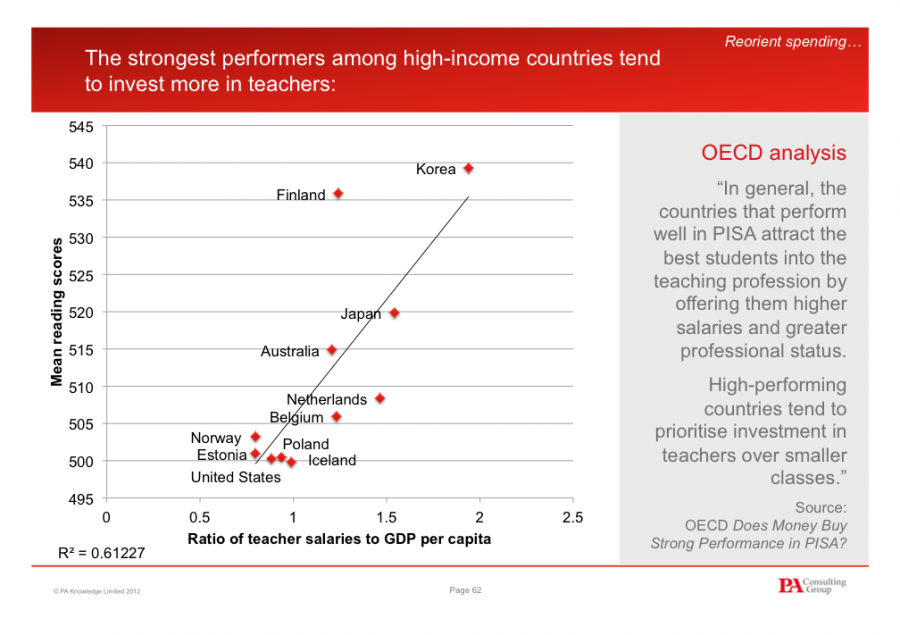
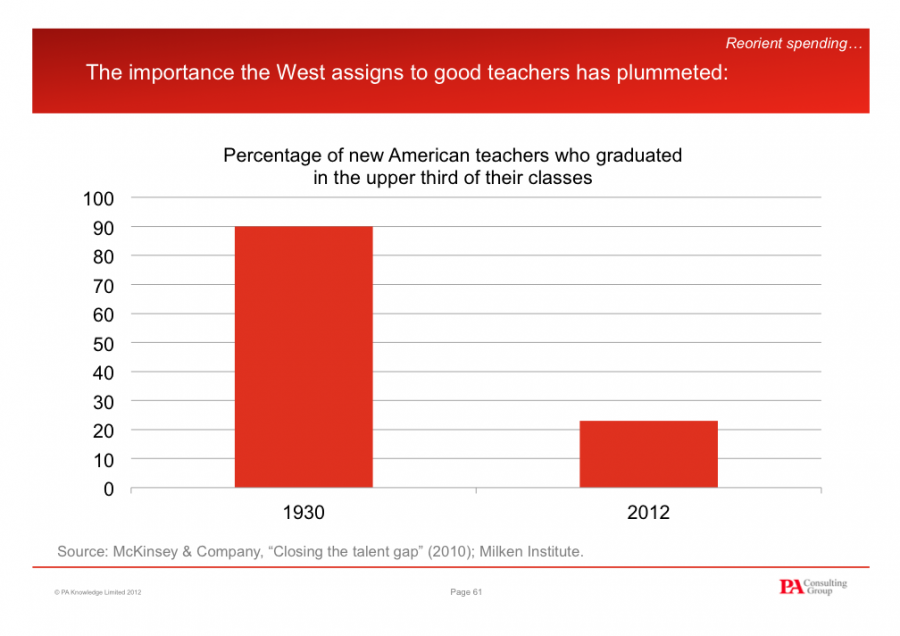
Derek Thompson has some lovely graphs that show the decline of the Western Empire. Yes, a little cheerful reading for your holiday week. Check out the teaching graphs:
Leave saving the world to the men? I don't think so.

Derek Thompson has some lovely graphs that show the decline of the Western Empire. Yes, a little cheerful reading for your holiday week. Check out the teaching graphs:
Comments are closed.

 Apt. 11d
I dunno, I continue to believe education is an unexpected victim of broader employment options for women. (Same with health care – yesterday’s chief nurse is today’s neurosurgeon.)
My point here, I guess, is that I’m not sure we ever really had tons of respect for teachers. It’s just that now women can do other things.
LikeLike
Bright people scoring in the top 1/3 of their class want autonomy. They don’t want to be micromanaged and they don’t want to teach to the test, like their principals want them to do. So yeah, like Jen said, expanded opportunities for smart people (not just women), but also decline in relative freedom in the profession vis a vis the past.
LikeLike
1930 is a funny year to choose. There’s a very good book by Gilbert Highet called “The Art of Teaching” and somewhere in the book, he talks about what an excellent thing it was to be a teacher with a small but steady income during the Great Depression. For most people with a steady job, the Great Depression really wasn’t that bad. (2012 isn’t that hot, but if you compare what life was like at the bottom in the US in 1930 vs. 2012, there’s no comparison. As a thought experiment, try “Would I prefer to teach 8th grade or be on Medicaid and food stamps?” I think either way you chose, there would be regrets.)
It’s kind of unfortunate that the education workforce is so static. Otherwise, the current economic downturn would be an excellent time to hire talented unemployed people who would otherwise not consider teaching as an option.
Joanne Jacobs had an interesting post here:
http://www.joannejacobs.com/2012/08/irreplaceable-and-underappreciated/
“Principals don’t try to retain excellent teachers, concludes The Irreplaceables. TNTP analyzed teacher retention in four urban school districts: The top 20 percent of teachers, based on value-added scores, were nearly as likely to leave as the bottom 20 percent.”
Also, looking at this from a somewhat different angle, what do the Japanese get from their test scores? I was just looking at Japanese GDP growth from 1990 to the present, and it’s a nightmare.
http://www.tradingeconomics.com/japan/gdp-growth
LikeLike
I also think a part of this is due to technology. A lawyer can now represent clients worldwide. A software programmer can create a product used by millions of people. A salesman can contact many more people online than in 1930.
In comparison, a modern teacher can teach about the same number of students well that a teacher in 1930 could. (in my opinion) Perhaps fewer, with mainstreaming and the demands for “individualized” education.
In terms of “how many people can you serve,” in other words, the teacher is less productive than many other professions.
I know it’s anathema to think of teachers in terms of productivity, but teaching is not scaleable. (Yes, I am personally inclined to doubt that online instruction will enable one teacher to teach multitudes. YMMV)
LikeLike
I agree with everyone as to the second chart. I bet you could make the same chart about the plummeting importance of nurses and secretaries.
The first chart is completely inscrutable. The U.S., Norway, and Iceland are perfectly nice places. Maybe a mean reading score of 500 is perfectly fine. We could pay more to get it up to 540, I guess, but I don’t see a long line of Estonians lining up to emigrate to South Korea.
Regarding teaching in 1930, apropos of not much, I was reading the “American Girl” book series to eldest Raggirl a few years ago (“Kit Survives The Depression” or something), and in the back they have “True Facts” about life in the time period, and the book claimed that feminists in the 1930s argued that when they had to lay off teachers, that married women should be laid off first, because they had husbands, while single teachers needed to money more because they were living alone.
I guess it makes sense, but I can’t imagine feminists of any kind making that argument today.
LikeLike
Well, yes, but in 1930 it was also illegal to bring contraceptives into the United States. So lots of things were very different back then.
LikeLike
Maybe it’s not so much that teachers are underpaid in the US but that they’re underpaid relative to lots of other professions. If you think about countries like Scandinavia, there’s a relatively even distribution of the goods — that is, a doctor doesn’t make ten or twenty times more than a science teacher, and neither does a lawyer — so in Scandinavia, being a teacher is considered a good job because you’re not grossly underpaid compared to everyone else, and for someone good at math and science, switching to medicine instead of teaching wouldn’t net you twenty times more money. It’s not actually the teacher’s salaries are the problem, it’s the salary inequities between the various professions in countries like the US.
LikeLike
“In comparison, a modern teacher can teach about the same number of students well that a teacher in 1930 could. (in my opinion) Perhaps fewer, with mainstreaming and the demands for “individualized” education.”
Come to think of it, a circa 1930 class size would be very large compared to what we would be comfortable accepting today (not that large class sizes don’t happen today, just that we don’t see them as the norm).
Likewise, countries like Japan have very big class sizes. Look at the charts here on class sizes around the globe:
http://economix.blogs.nytimes.com/2009/09/11/class-size-around-the-world/
Very interestingly, Korea and Japan have some of the biggest class sizes on the chart (2nd and 3rd, 1st and 2nd, and 1st and 3rd). So, what is probably happening here is that Korea and Japan have fewer teachers taking bigger slices of the GDP pie (and hence individually getting more pie), while in the US, we have more teachers taking more slices (hence individually getting a smaller share of GDP, but enjoying the blessing of smaller class size).
LikeLike
I agree with the comments re: women’s opportunities and smart folks wanting autonomy, but there is another issue, too.
I finished undergrad in 1995, with a 3.94 cumulative GPA (not bragging–keep reading for relevance). I was an English major and certified to teach grades 7-12. I applied to over 50 school districts, had seven interviews, and didn’t get a job. One principal told me I was too smart and that students wouldn’t be able to “relate to” me. Two told me I was the best candidate but the school needed someone who could coach (volleyball and I forget the other sport). Another principal was extremely hostile during the interview and, because I acted in several plays during college, accused me of being a fake who didn’t truly care about kids; he added, how do we know you’re to going to run off to New York and abandon our kids?
Another principal said that I wouldn’t be able to control a classroom because I have a slight hand tremor. Finally, the last school I heard from told me they went with a more experienced candidate; thIs was after I was thoroughly questioned about my marital and pregnancy plans. The other never contacted me after the interview.
This is why the top students don’t become teachers–their intelligence is seen as a negative or is unimportant compared to their coaching ability. I certainly wasn’t going to tolerate that principal’s abusive behavior (I left the interview early because of it). I subbed during my first year out of college, and I quickly realized I would have no autonomy. Every decision the schools made was driven by fear of parental lawsuits. I wanted no part of it.
In comparison to all of that, the academic job market was more humane, and teaching is far more enjoyable as a professor.
LikeLike
Oh, and I also heard the “too smart” comment from local principals during my college’s mock interviews. It wasn’t a one-time thing.
LikeLike
As harry b has mentioned more than once, US principals are not drawn from our top teaching talent. It is only natural that mediocre people feel most comfortable hiring other mediocre people.
And as I’ve said here before, there’s a lot to be said for school models where there’s not such an air-tight division between teaching and administration. In our public system, (generally speaking) principals don’t have teach, didn’t teach academic subjects in the past, probably never were very good teachers, and have little insight to offer their teachers on pedagogy. There is no reason why it has to be that way. When I taught in a public school in Russia, my principal continued to teach her subject (Russian literature). Likewise, her vice principals also continued to teach their subjects. That was possible because the teaching schedule did not require a full-day commitment from every teacher. I think it’s very good for administrators to keep a foot in the classroom, as it keeps them more realistic in their demands as well as preserving their street cred with their teachers.
LikeLike
Amy P that is very interesting because I went to Catholic schools back in the 70s and 80s when there were still a lot of nuns running and teaching the schools. The principals all had teaching experience and though my high school principal did not teach there were students who had older siblings who remembered her as a teacher. The vice principal taught as did at least one of the guidance counselors (there were 3 full time counselors for 450 students – boy were we lucky). Of course, nuns were cheap and tuition was 900/year – so low that some girls paid their own way with morning paper routes.
LikeLike
Independent schools don’t have this problem. The pay is similar and even sometimes lower, but your intelligence is valued and you have autonomy. Our administrators teach. In a place with many independent or charter schools, I bet the talent goes to those rather than the publics.
LikeLike
There isn’t a lot of evidence that the supposed decline in teacher quality has lead to worse outcomes for children. Most of the research suggests the opposite is true: things have been getting slowly better for the last few decades.
So I’m skeptical of the entire enterprise of focusing on teacher quality as the silver bullet to becoming the next Finland. The reason Finland does so well has less to do with their teachers and more to do with the structure of their school system and the resources they invest in the whole population.
LikeLike
I should say that Finland does a lot of things right in terms of teacher preparation and if we were to implement their model here I think it would help draw talented people into the education workforce. But even if we did all of those things we still wouldn’t be seeing child outcomes anywhere close to Finland’s.
LikeLike
“There isn’t a lot of evidence that the supposed decline in teacher quality has lead to worse outcomes for children. Most of the research suggests the opposite is true: things have been getting slowly better for the last few decades.”
Middle class US parents are putting a heck of a lot more time and resources into their kids than they ever have before, which is compounded by their having much smaller families, as well as by the fact that kids spend a lot more supervised time indoors at home than they ever have. And then there are companies like Princeton Review, Kumon, Huntington, Sylvan, etc. that exist to supplement deficiencies in both school and home. School is not the only variable here.
LikeLike
Amy P that is very interesting because I went to Catholic schools back in the 70s and 80s when there were still a lot of nuns running and teaching the schools.
So did I. The principals of both the grade school and high school were nuns and both taught classes. The grade school principal was teaching full time (3rd grade). The high school one only two or three periods a day (biology and religion). The superintendent taught also.
LikeLike
Wow. Thanks for sharing those stories, Sara!
LikeLike
I think I remember that one of my Russian vice principals was a physics/math teacher. You’d have to look pretty hard in the US to find somebody with a similar career path.
LikeLike
You’d have to look pretty hard in the US to find somebody with a similar career path.
Angela Merkel?
LikeLike
Geekymom is right–independent schools do this much better. The Head of my K-12 school is a former kindergarten teacher.
LikeLike
Geekymom and Jackie, this is one of the many reasons why M will be transferring from public school to an independent school this fall. 🙂
LikeLike
I have one child still in public school and the principal is a former phys ed teacher. What kills us is that she stands up every year and says “This is the best high school in Virginia!” when it failed to get accredited two years in a row, and everybody knows which high school is the best one in Virginia. It’s the one in Fairfax county with all the intel winners. It’s very strange that she’s so comfortable lying to everyone.
LikeLike
“…the principal is a former phys ed teacher.”
That is the classic scenario that harry b mentioned on a previous occasion.
“What kills us is that she stands up every year and says “This is the best high school in Virginia!” when it failed to get accredited two years in a row, and everybody knows which high school is the best one in Virginia. It’s the one in Fairfax county with all the intel winners. It’s very strange that she’s so comfortable lying to everyone.”
Thomas Jefferson, right?
Would it make you feel better if she wasn’t lying, but really didn’t know any better?
LikeLike
That chart seems misleading in some ways. It seems to equate the United States and Estonia, for example, both in teacher salaries and in student performance. But if one looks at actual dollars and purchasing power, Estonian teachers earn the equivalent of about $10,000 per year compared to about $44,000 for U.S. teachers with the same amount of experience. See the second chart here, where the U.S. is at the middle to high end of the pack: http://economix.blogs.nytimes.com/2009/09/09/teacher-pay-around-the-world/
LikeLike