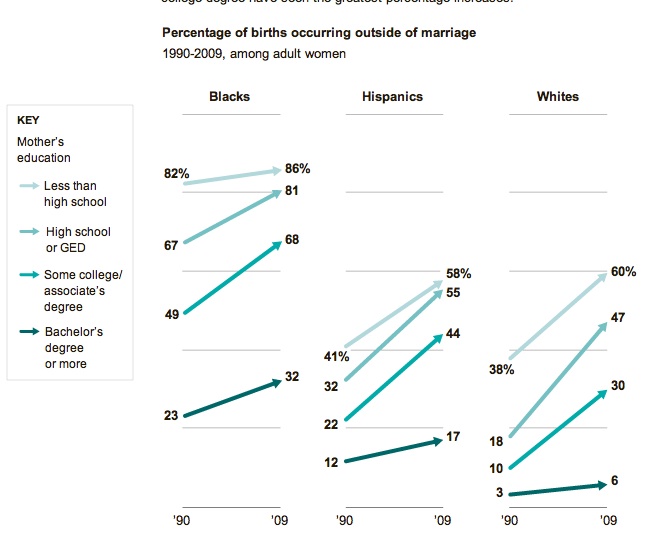
From a great article and larger chart on the rising rate of single parent families in the New York Times.
Leave saving the world to the men? I don't think so.

From a great article and larger chart on the rising rate of single parent families in the New York Times.
Comments are closed.

 Apt. 11d
The only happy thing I can think of here is that higher education is a lot more prevalent today among young people than it was in 1990, so the chart is somewhat less dire than it looks.
LikeLike
As I understand how the numbers have worked, teenage childbearing is way down. Is it possible that what we’re seeing is partly just women having babies outside wedlock who would previously have done so in their teens?
LikeLike
Amy P
Those are good points. Also, yeah, it seems like delaying single motherhood until the 20s would be more beneficial than having kids in adolescence for struggling moms, even if the moms are still struggling in their 20s (though, there’s evidence than when you get low enough, teen moms in ghettos do better than their childless counterparts.) The income thing seems big. At the level where people are earning 20-40k, doubling household income really would be the difference between making it or breaking. Or even one income with a SAHP who could full time look after the kids and run a thrifty household would be a lot better, since things that are cheap/free often require lots of time to do well, and making sure you’re getting all the benefits you can for poor kids requires lots of time and savvy that an overworked parent might not have.
What’s also sad about these sorts of stories are the lack of grandparents or other friends and family networks. If the struggling mom had parents who could watch the kids after school and take them to some activities and maybe even pay the fees, that would make a huge difference. Even a childcare sharing arrangement with neighbors could be a lifesaver. Of course, poor people who have little time to socialize and move frequently around apartment complexes are least likely to have social ties to the neighborhood. I’m wondering though, if her church might offer more opportunities? Church youth groups can provide Boy Scout-like opportunities and usually don’t cost money, and the church should have some sort of support for struggling members.
My dad died when I was 10, so I always wonder where I fall on the single parenting scale. I had the classic 2-parent model with a SAHM in early childhood, my mother got SS survivor’s benefits which softened the otherwise significant financial blow of losing the main breadwinner, and we had a full-on grandparent & neighbor & church support system. My mom did a lot, but a lot of other people stepped in to help raise us in really significant ways, including my best friend’s parents who I call my second set of parents. I don’t think I’d be where I am today without all their support, and I am especially grateful for all the people who stepped up to be “dads.” Of course, all people could benefit from an increased social support network, but it’s especially valuable for those on the margins.
LikeLike
I’m intrigued by these stats. The jumps since 1990 are huge, and to me surprising because of when they occur. I’d have thought that the social changes that legitimized single parenthood (to the extent that it is legitimized) would have occurred earlier for the most part. What was happening in the last 20 years that caused such big increases in single-motherhood among less educated women?
Since my experience is with the 3%, where single motherhood is rare, and when I see it, very much of the “single mother by choice”, it’s not something I was aware of until seeing the stats.
One question I have is what percent of births are happening in each of those categories. what percent of children are born to each of the 4 groups of women (in addition to the percent born to unmarried women)?
LikeLike
the proportion of college educated people (I think not just women) seems to have gone from about 20% to 30% between 1990-2010.
LikeLike
The Pew charitable trust report seems to answer some of these questions (and yes, the proportion of children born to women w/ some college education has increased since 1990, presumably because more women are college educated?)
LikeLike
http://pewresearch.org/pubs/1586/changing-demographic-characteristics-american-mothers
(a link to the report)
LikeLike
You know, Charles Murray really screwed himself over by writing that awful book on race a few years ago. Nobody believes anything that he says anymore. I hate to say it, but his book discusses this trend in depth.
I think the jump in single parent birth among lower income families is real and not some statistical weirdness. My low income cousin has three girls who are all teenage parents. What’s going on? 1. Growing social acceptance of single parenthood. If everybody you know is a single parent, then what the hell? 2. Zero penalties for single parenthood. You’re poor and have few options, whether or not you’re a parent. 3. In the Hispanic population, decline of Catholicism is a factor.
LikeLike
I’m guessing a decline in adoption plays a role as well (which in turn, was partly of the social stigmatization). My vague anecdotal feeling is that women unwilling to have abortions were more likely to give up their children to adoption (though I’d like to see the statistics).
I’ve learned of this growing social acceptance of single mother hood via bulletin boards and the like, but it is definitely not in my frame of reference.
I worry (again anecdotally) that part of the increasing birthrates among the poor might be social/moral/other forces that make it increasingly difficult for that group of women/girls to refuse sex, demand use of birth control, and or issues with accessing birth control (including religious concerns). In my mind, I’m thinking about Africa, where I believe a significant part of the problem is the lack of women’s empowerment.
Makes me wonder what percent of births in these different categories are unplanned? What percent are wishful thinking (or mistaken beliefs about fertility)?
LikeLike
BI said:
“Of course, poor people who have little time to socialize and move frequently around apartment complexes are least likely to have social ties to the neighborhood. I’m wondering though, if her church might offer more opportunities?”
Nowadays, poor Americans are less likely to be involved with religious organizations than more prosperous Americans, just as they are less engaged with community life generally. It makes poverty that much more inescapable if you don’t know anybody well outside your immediate circle and nobody knows you and nobody wants to help you.
I think Putnam is pretty persuasive about linking 20th century social disengagement to the rise of TV. (Not that I’m personally in a hurry to replace a solitary evening of watching Midsomer Murders with my husband with bridge with the neighbors.) I think I remember seeing some research a few years back about how watching a lot of TV creates the illusion of having a lot of friends. TV is to social capital as Splenda is to sugar. That’s probably also true of a lot of electronic media.
http://www.scientificamerican.com/article.cfm?id=imaginary-friends
It will be interesting to see what the research on social media will show. Do social media create social capital, or just the illusion of social capital?
bj said:
“One question I have is what percent of births are happening in each of those categories. what percent of children are born to each of the 4 groups of women (in addition to the percent born to unmarried women)?”
My intuition is that single motherhood (or the prospect of imminent single motherhood) tends to suppress birth rates. I suspect that that’s one of the contributing factors to Russia’s dismal birthrates–while it’s possible to be a competent single mother to one child, it becomes less and less feasible with a larger family. Over the years, I’ve been friends with a lot of Russian divorcees with exactly one child. The Russian families I knew with two kids tended to have both mom and dad around, with dad putting in at least some effort. Married parents with a functioning relationship have better domestic infrastructure for raising more kids.
LikeLike
It looks like the raw numbers are that births to married couples declined from 3M to 2.5M per year, while births to unmarried women increased from 1.1M to 1.7M.
Assumedly, many of these births are to unmarried cohabiting couples, so I don’t think it’s fair to call them all “single parent families.” Some are, and some are unmarried multiple-parent families.
Charles Murray decided to avoid the race problem by limiting his analysis to white families when, it seems, Hispanic families seem have largely converged with white families, while black families have not. That doesn’t really avoid the race problem.
LikeLike
“Charles Murray decided to avoid the race problem by limiting his analysis to white families when, it seems, Hispanic families seem have largely converged with white families, while black families have not. That doesn’t really avoid the race problem.”
I think it’s also untrue to the reality on the ground to study poor whites in isolation. My feeling is that in a lot of places in the US, poor whites live pretty close to poor Hispanics and poor blacks and go to the same schools and have kids together and there is a lot of cultural convergence. (At least that’s how things seem to work here in Texas.)
LikeLike
I blame the rise of single parent families on all the slutty clothing and come-hither looks of the girls in the think tanks.
LikeLike
Amy P
Is that really true about church? I thought church attendance was up in the past 20 years. Also, the woman in the NY Times article went to church every Sunday. I’m surprised they’re not helping her a little more.
I also think that births to unwed mothers is a bit of a crude statistic to get at single parents. Probably mostly in that 6% elite, I know a fair number of hippies and gen Xers in LT relationships with kids who don’t get married but otherwise are stable 2 parent households (my generation seems to marry more). Also, Europeans, but they’re obviously not relevant. Probably more common are parents who get married because the woman is pregnant and divorce soon after. The woman in the article honestly was with the father for the length of the average marriage, but marriage doesn’t make people automatically into reliable parents, so I’m not sure if it’s really a lack of marriage that’s the problem, or if it’s a proxy for a lot of other problems.
With black women, a big part is probably lack of marriageable men. My black female friends in college would complain bitterly about this, and I’m too lazy to check it up, but an African American man is some shocking amount more likely to be imprisoned than get a BA. Even if you don’t mind marrying someone with a record, so many men are locked up at one time there’s also a simple shortage of bodies. Also, towards the bottom, being a single parent is probably better than being with a deadbeat, unreliable parent. There was a shooting recently where a 10 year old girl was shot while playing in a fountain with her mom’s boyfriend. It turned out the boyfriend was a gang member, it was a gang shooting, and the girl was collateral. If I were the mom, I would weigh “fatherlike figure” with “likelihood of my daughter getting shot” pretty carefully.
Since I’m a Leftist, I’ll add that there are structural reasons to why people join gangs and also why marriage is uncommon in the inner city, which include access to gov. benefits. It’s harder to qualify for things when there’s a 2 parent household, and if the second parent is unemployed/unemployable, there’s no monetary advantage to being married. I lived in an apt. which I later found out had its own gang affiliation, and in the summer lots of teens would gather in the front courtyard to talk. I chose to ignore the annoying aspects of having loud teens in groups outside my window at 1 am and focus on the sociologically interesting parts (aka eavesdropping). One night the kids were talking about their future goals. The boys all said their goal in life was to get married and have a family they could provide for. All of them agreed that supporting the “mama and baby” and marrying her was the manliest thing they could do. In terms of values, I really stand by the idea that the poor really do have “red state” values. As David Brooks points out, it’s the latte liberals espousing free love, even though they’re not practicing it, or they’re practicing a version that still results in middle class morality (like aborting a child you’re not prepared to have, and then having the family you are prepared to have, when you’re prepared to have it, or adopting a kid with your gay spouse).
LikeLike
Oh, as long as I’m writing a novel, for what it’s worth, I wouldn’t necessarily marry if I were to get pregnant, at least not right away. If I broke up with the dad though, I would work very hard to maintain a co-parenting relationship, and at minimum I would make sure the dad were paying child support, and I would fight very hard if he tried to bail on this.
LikeLike
I also think that births to unwed mothers is a bit of a crude statistic to get at single parents. Probably mostly in that 6% elite, I know a fair number of hippies and gen Xers in LT relationships with kids who don’t get married but otherwise are stable 2 parent households (my generation seems to marry more).
I also know a fair number of white, educated heterosexual couples who believe that it is morally wrong to get married when their homosexual friends cannot do so (in Pennsylvania or New Jersey, in particular). They’ve done all of the contractual things that gay couples do to approximate marriage rights without actually tying the knot. Don’t know if that’s a statistically significant number of the 6%, but I’m guessing the college educated whites tend to disproportionately be the ones who do things like that.
LikeLike
Yeah, Murray was spot on. Another problem was the title of this article, which was Two Classes, Divided by ‘I Do’ and it should have been ‘Dan Qayle, we’re sorry, you were right and we were wrong’.
LikeLike
We could change the spelling to “potatoe”.
LikeLike
BI said:
“Is that really true about church?”
Yep. From a Huffington Post piece:
“According to the study, in the 1970s, 51 percent of college-educated whites attended religious services monthly or more, compared to 50 percent of moderately educated whites and 38 percent of the least educated whites. In the 2000s, 46 percent of college-educated whites attended on at least a monthly basis, compared to 37 percent of moderately educated whites and 23 percent of the least educated. The study defines the “least educated” as people without high school degrees.”
http://www.huffingtonpost.com/2011/08/21/church-attendance-falling_n_930036.html
LikeLike
This was interesting, too:
“Wilcox says his study focuses on whites because attendance rates at religious services among minority groups such as blacks and Latinos is less likely to be linked to education and income.”
LikeLike
Children born to unmarried parents is not equal to single parenthood. That is all.
LikeLike
From the NYT article: “…nearly half the unmarried parents living together at a child’s birth split up within five years, according to Child Trends.”
LikeLike
I wonder what that figure is for married parents?
LikeLike
The income thing seems big. At the level where people are earning 20-40k, doubling household income really would be the difference between making it or breaking.
Yeah, in theory. In reality, women who are in that earning bracket find few available men who are also in that bracket—they’re either earning more (and expect to marry women who are also educated and earning more), or they aren’t earning—they’re perpetually between jobs. College educated men are almost always earning more than 40 grand, and they don’t date high-school educated women. That’s even true of the (for lack of a better term) “upper working class”; my union brothers who are married have wives with college degrees—they wanted middle-class lives, and the way to get there is to have a spouse with similar earnings.
Anyway. “Promises I Can Keep”–it’s not just operative for poor women, but for working/lower middle class women too.
LikeLike
Getting married at twenty should fix that. Nobody earns any money then.
LikeLike
“Wilcox says his study focuses on whites because attendance rates at religious services among minority groups such as blacks and Latinos is less likely to be linked to education and income.”
“Wilcox says that his study limited its attempt to conflate correlation with causation to correlations among whites because with blacks and Latinos, there wasn’t even a correlation.”
LikeLike
Oh, and here is some non-anecdotal evidence on poor people and attitudes towards marriage:
http://www.sciencedaily.com/releases/2012/07/120716163241.htm
LikeLike
Ragtime said:
“Wilcox says that his study limited its attempt to conflate correlation with causation to correlations among whites because with blacks and Latinos, there wasn’t even a correlation.”
Were we even talking about correlation vs. causation? While that is a very interesting question, the bottom line is that contrary to popular stereotype, poor whites are not big church goers.
LikeLike