
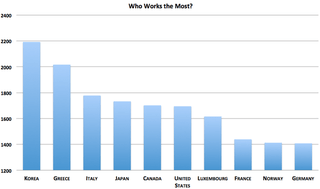
 Derek Thompson has a couple of very funny charts on the Atlantic. Chart One shows that every country in Europe thinks that Greece is the laziest country, while the Greeks think that they work the hardest.
Chart Two (on the left) shows that the Greeks are right. They do work a lot, but their work is less profitable than work in more industrialized nations.


My German in-law would have something to say about this. It’s one of his gripes about the US that there’s a lot of office time, but that a lot of US workers treat their time at work primarily as a social opportunity. He wants to work at work and then go home (and work there, too, but at his 2nd, 3rd and so forth jobs). I suspect there are rather large cultural differences in how people expect to spend their workday in different countries.
I’d also note that the hours officially worked may be inverse proportional to national honesty. 1) You have to show up at work to steal from work. 2) Longer hours may reflect time-sheet padding and personal errand-running and abuse of company supplies (computers, etc.) for personal ends.
LikeLike
There may be some perverse national pride going on in the “most corrupt” category. The Greeks think they are most corrupt, but the Poles, Czechs and Italians think the same of themselves, too.
I think you might get some amazing turnarounds by introducing air conditioning to some of these warmer European locations. The US South has been economically transformed by having civilized indoor temperatures during the summer (and hookworm eradication, they say). You try to get much done in 100+ degree temperatures–it’s positively dangerous. Mediterranean Europe doesn’t have quite as good an excuse as the US SE, but it would be an interesting experiment.
LikeLike
I don’t understand the Greek data. Doesn’t Greece have something like 30% unemployment? Either those are old numbers or they refer to the hours worked only those work are working or they include non-paid work or I’ve missed something. I tried to follow the link on Thompson’s post but it lead to nowhere obviously useful.
LikeLike
“Either those are old numbers or they refer to the hours worked only those work are working…”
I think that’s it–from reading the Thompson comment thread, I think it’s supposed to be hours worked by employed people.
LikeLike
If we are looking at those, I thought what that tended to show most was the percentage of women in the workforce (e.g. people working long hours tended to have non-working spouses).
LikeLike
And, also that those who work have to work more, to pay for things for their family, and to accomplish what they accomplish (because so many people aren’t working at all).
I find that a lot of the Italians who work really work hard, because they’ve made it hard to work and get anything done. So, if you’re a scientist, who is competing on the international marketplace, and working in Italy, you have to work harder to get stuff done (because others around you aren’t working as hard).
For Germans, I’m guessing everyone carries their own weight.
LikeLike