Important laws are being crafted at state capitals across this country about things that you care about — gay marriage, gun regulation, abortion, schools, drug policy, and state colleges. In fact, you probably have more opinions and personal interest in things going on in your state capital, than you do in Washington. But you probably aren’t hearing about it on the local news shows or in your local paper. These laws are being crafted in the dark.
Partly, this is because you aren’t reading your local paper or watching your local news. Most of those news sources don’t exist anymore. And you are too distracted with all the other fun things on the Internet to find the weird cable channel that does cover this information.
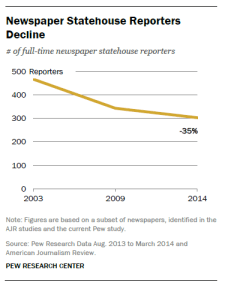
Pew has some great statistics on the decline of news coverage of state politics. In the past ten years, there has been a 35% drop in the number of reporters covering state politics.
On average, there are 15 full-time reporters working in each statehouse, but the total varies from state to state. The largest full-time contingent (53 full-time reporters) works in Austin, Texas, followed by 43 full-timers in Sacramento, California. Conversely, the state with the fewest full-time journalists at the capitol is South Dakota, with only two; one of them works for the Associated Press and the other writes for six newspapers. The Pew Research study found a clear correlation between the population of a state and the size of its statehouse press contingent.
Who’s filling in the gap? Students, non-profits, probably some state politics bloggers. But that’s not enough.

 Apt. 11d