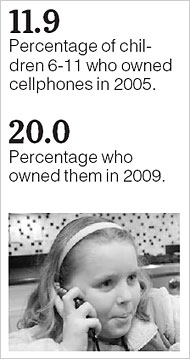
 Last Christmas, after much internal debate, we got Jonah an iPhone. He joined the 20% of American children who have their own phones.
With two kids arriving home at the same time, after-school pick up was complicated. Jonah and I needed to confer about getting home on snowy days, and he needed to tell me about spontaneous review sessions with his teacher. He had been agitating for one for ages, because his friends had them. We decided on an iPhone, because I was getting one, and we could put both phones on the same phone plan.
On hindsight, the iPhone was too much phone for Jonah. He didn't need access to the Internet or apps or anything. A cheapo model would have been better, but you can't take back a Santa present (without just cause), so we have to live with it.
Our town had a well publicized scandal last year. Middle school girls sent pictures of their boobs to their boyfriends using the school's e-mail system. The boys thoughtfully shared those pictures with the rest of the community. The school was in danger of prosecution for distributing child pornography, since the photos were distributed through the school's mainframe.
This wasn't an isolated incident. A girl who lives down the block received pornography on her cell phone from a disturbed boy in her class. Through the grapevine, I heard about harassing text messages and other garbage.
Knowing about these problems, we established certain rules for its usage.
We told Jonah that if he gets an inappropriate text message or photo, he had to tell us about it immediately. If he told us, nothing would happen to him. If he got something and didn't tell us, he would lose the phone.
How would we know if he got something that was inappropriate? We told him that we would read all his text messages and e-mail conversations. We read these message on his phone or on the AT&T website. We explained that anything sent via the Internet is NOT PRIVATE.
This is actually a lesson for everyone. Information can be forwarded or accidentally sent to the wrong person extremely easily. Workplaces are increasingly reading all Internet communication, because they are held legally responsible for the content of these communications. One off-color e-mail in the workplace can be cause for immediate dismissal. Former friends or boyfriends can post private information on the Internet, which future employers will find. It's stunning how many teenagers do not know the important rule that one should never post pictures of your boobs on the Internet. Ask all those former American Idol contestants why that's a bad idea.
We also had to put in major parental controls on that iPhone. Without the parental controls, Jonah would have access to wonder apps, including The Sex Positions Game and 69 Positions Lite.
We took off the YouTube app, because a search for SpongeBob can easily lead to a homemade film of Spongebob doing unspeakable things to Patrick. There are no parental controls for YouTube.
We also had to establish certain rules about phone etiquette, including one should not text, while your grandparents are visiting. Never text at the dinner table. No staying glued to the iPhone for more than five minutes, unless you're Mom and the Oscars are on.
With those rules and some serious parent controls, we haven't had any problems. I've checked out his texts. It's mostly he and his friends laughing their asses off over the creative use of the word "fart." He did get a text from a precocious girl in his class that said, "I love you. Only kidding." Jonah was too horrified and confused to deal with it, so I wasn't that worried.
Technology has increased the difficulty level of parenting in many ways. Most parents don't know how to tweak the programs to protect their kids. They don't know that they need to regulate its usage.

 Apt. 11d