Earlier in the week, I posted a couple of links to discussions about comparing time in school in American schools vs. schools abroad, and we had a great discussion about the benefits of a longer school day.
In the New York Times, Geoffrey Canada, the president and chief executive of Harlem Children’s Zone, wrote, "When you look at our (roughly) 180 school days in comparison with Japan
and Germany (about 240), you see how our children are underprepared for
competition almost from Day 1."
In Atlantic Monthly, Conor Clark provided a handy chart to show how far we lag behind Asian countries in terms of days spent in school and argued that we really need a longer school year in the US in order to compete.
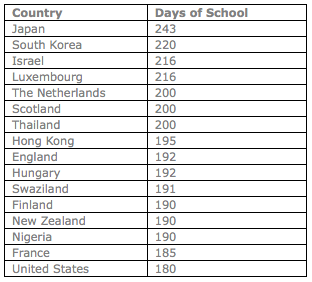
We may really need a longer school year in the US, especially for low-income children. Research does show that it helps lower-income kids, though there's no evidence that it would benefit other children.
There may be excellent reasons to extend the school year, but comparisons with schools abroad may be misleading. Commenters on this blog really put some serious holes in these international comparisons of the school year.
Claudia writes,
Re the 240 days at school in Germany: hell, yes. Because my kids (1st and 2nd grade) come home at 11 am.


Amanda writes,
Three cheers for the collective knowledge of the blogosphere.
Ever since the 1983 publication of the Nation at Risk, Americans have been very insecure about the comparative value of our schools. Tyack and Cuban's Tinkering toward Utopia: A Century of Public School Reform is a great book, which questions those arguments.