
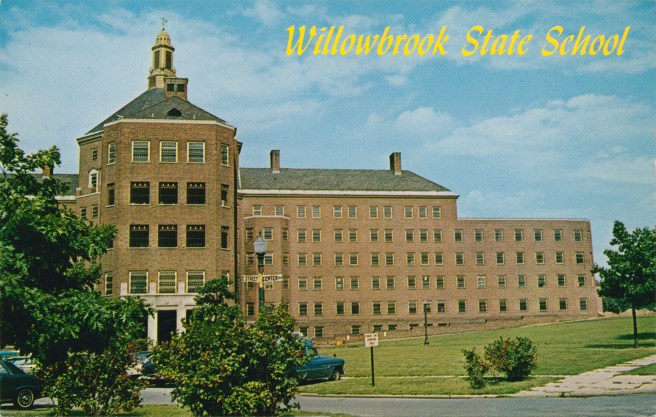
Source: NYPL – Public Domain
When Jennifer Senior’s aunt was two years old, doctors diagnosed her as a hopeless case, “a microcephalic idiot.” Adele’s brain was compressed by the bones of her skull due to a rare chromosomal irregularity. At that very young age, she was sent to the horrific Willowbrook School on Staten Island, and later to other institutions for her entire life with almost no contact with her family. Only now in their 70s, Jennifer’s mom and sister are getting to know each other.
This tragic tale, told expertly by Senior in The Atlantic, was the norm during our sanitized mid-century years. Disabled folks, instead of being folded into the family farm and with an extended family to offer companionship, were hidden away. They were an embarrassment to a post-war world that valued progress and modernity. Just a few years earlier, Rosemary Kennedy was given a lobotomy because her father wanted to keep his intellectually disabled daughter under control.
Senior maintains that these two sisters would have benefitted from a closer relationship. Despite their differences in IQ, they share many common interests. Senior contrasts their situation with modern disabled families, whom she says are supported by generous state benefits. Her article is, in some ways, the flip side to the article in The Free Press that I talked about last week, by a mom who despaired about the lack of attention to her and her very autistic adult-children.
While society is much more inclusive than the terrible midcentury years, there is still much to do. Families fail to get much actual support. Mothers quit their jobs to handle the therapy schedule and attend IEP meetings. Later, parents pray that they will outlive their children, because there is not enough supportive housing and other facilities for their adult-children. Government closed the institutions, but they didn’t put anything in their place.
Read more at Apt. 11D, the newsletter

 Apt. 11d
Those involved in the long struggle to close the truly dreadful institutions, like Willowbrook, certainly worked to find alternatives, including, for example, the system of regional centers in California (they are celebrating their 50th anniversary, so celebratory history is available on the internet): https://www.inlandrc.org/2022/02/28/inland-regional-center-celebrates-50-years-of-service/
Providing support for different individuals with different needs is indeed a knotty problem, and not being on the ground navigating so I do not know any practical information. But, I do believe there are people trying hard to help people with disabilities, including in government and that the institutions that were closed were truly awful and that some that remain open, even under court monitoring, are failing miserably. I hope there will be good conversations about how to help people who want and need different things.
LikeLike
The head of the office at my first real job collected post cards like that. A major focus of that job was following people who were deinstitutionalized. DeWine dropped the whole office.
LikeLike