
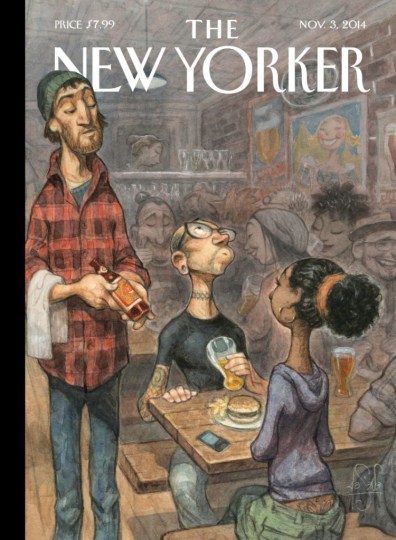
Flipping through the articles in the food issue of the New Yorker, I’m struck by the glaring gaps between the foodie world and the non-foodie world.
We live pretty close to Manhattan, so our idea of a fun time is go into the city on a Saturday night and eat weird food. We take the kids and go for German barbecue places in Williamsburg or elevated English pub grub in the West Village. I research new restaurants. I follow them on Instagram. I like rustic places with large portions, energetic staff, and a relaxed atmosphere. There are really, really good restaurants in NYC and a few other cities right now.
I also cook a lot at home. Before my kids go trick or treating tonight, they’ll get a bowl of potato-leek soup.
This is not how most of America eats. That is not most of America how cooks. I like that the New Yorker is pointing out that there is this amazing world of food out there right now, but they should also mention that only a very small group of people is able to access it. This food revolution is elitist. I feel like a whole edition of a magazine devoted to food should have some discussion of the food habits of most Americans.


I was minding my own business one day earlier this week. Just walking to the soccer fields. I came across people selling yak lard. I thought about buying some to make pie crusts with because trolling my relatives at Thanksgiving is fun.
“Where did you get this pie?”
“I made it.”
“Really, how did you get the crust so flaky?”
“Yak lard.”
LikeLike
Anyway, the yak lard was too expensive for that, especially considering that I can just use Crisco and say it’s yak lard. How is anybody going to know.
LikeLike
The cognoscenti will know. Yak lard has a distinctive bouquet, especially if the yak in question was pastured on the south side of the vineyard.
LikeLike
Once you go yak, you never go back.
LikeLike
Yakitty-yay, won’t go back!
LikeLike
Doug, this has nothing what-so-ever to do with the topic, but as an Edwin Edwards groupie you should see: “…The most awkward kabuki dance was performed by Kentucky senatorial candidate Alison Lundergan Grimes. She refuses to say whether she voted for Obama, notwithstanding the fact that she was a delegate at both party conventions where he was nominated.
The same question was put to convicted felon Edwin Edwards, now out of federal prison and running for Congress in Louisiana. He aced it. “I did not vote for Obama,” Edwards replied. “Where I was there were no voting machines.””
(http://www.realclearpolitics.com/articles/2014/11/02/democrats_cold_shoulder_season_124524.html#ixzz3Huv8lwM8 )
LikeLike
I’m the wrong gender to be an Edwards groupie, but I do appreciate his quick wit.
LikeLike
Heh.
LikeLike
When I lived in Denver for a year (in a sort of Yuppie neighborhood that was close to where I was working at the time) a guy would sell Yak meat at the farmers’ market. I bought some burgers a few times (good, but a bit lean for my taste. It needed more lard!) But, he’d often bring down a yak from the herd with him, and that would make me feel a bit bad. (I don’t remember him selling lard on its own, though.)
LikeLike
The New Yorker writes for an elite audience. I can’t see them covering much of what happens outside of that world.
Is it an upper middle class thing to be a “foodie?” When I vist my blue collar relatives they have zero interest in the “food revolution,” and it is not all about money. Some of them did well before the rust belt, socked it away, and could afford the food and restaurants. They see being so interested in food as silly or frivolous. And they don’t read the New Yorker.
LikeLike
Traditionally, the New Yorker wrote for a middle class audience that wanted to think it is reading something written for an elite audience.
LikeLike
Or if they pay big bucks for food, it better be a steak or lobster, not pickles or apples!
LikeLike
I took my midwestern in-laws to a great restaurant here that’s all organic and local. They had detailed descriptions on the menu about where the food came from. My in-laws made fun of it, and I’m sure they made fun of it for days and weeks afterwards (we’re the weirdo relatives who live in the big city). That was over 10 years ago. Now my sister-in-law buys organic all the time and talks about how much better it is. Which cracks me up, because her husband was one of the biggest poo-pooers of the organic food that day. Now the rest of the family still dumps things out of cans and heats things up in the microwave (when they’re not eating out at chain restaurants), but I’ve watched at least one mainstream family get on the semi “foodie” side of things.
LikeLike
there is this amazing world of food out there right now, but they should also mention that only a very small group of people is able to access it.
When I was visiting my family in Boise, Idaho this summer I was really surprised at how much better the restaurant scene has gotten in just the last few years. There are now quite a few really excellent places, especially given the size of the city, and a pretty good variety, even. I’m sure there are still some real wastelands out there, but in general I think that there are pretty good culinary opportunities for a large percentage of people who want them.
LikeLike
One of the more astute comments I’ve heard about this came from an African-American worker at Trader Joe’s in DC, who was training a new stocker while I was standing nearby pondering which kinds of nuts to buy, in what configuration. The trainer and trainee were having to make their way through many customers who were also standing and looking at the shelves and pondering. “People here spend a lot of time looking at the groceries,” he said to the new guy. “Not like in the hood – they just get in and get out.”
LikeLike
I am dying to head to Kinston, NC a town 90 miles from our city to go to Chef and the Farmer. I want to try her food, desperately. We’d want wine pairings and mother earth beer, so it would require a nights stay, a weekend trip for 1 meal. Its ALL local, meat, fish, produce. The town’s downtown has literally built an economy because of 1 restaurant and restaurant tourism.
We don’t eat like alot of our friends. We think of food as entertainment, expensive and an experience. I love to cook and love trying real chefs food and then try to replicate at home. We’ve moved from chains for ease, to locally owned, operated and sourced. It just tastes better and honestly, I hate spending money on crappy meals at restaurants.
LikeLike
I met a woman from Asheville at a food photography workshop that I attended last weekend and she was ALL over Chef & the Farmer. Heard great things about it. Enjoy!
LikeLike
The French model, or at least the historical one, right? Where you can have a town built around a resterant. I was reading a NYorker book of food essays recently themed on that topic.
Food is not my think, and I am emphatically not a foodie. I don’t mind good food, it does not spark my aesthetic interests, though reading does, including about food, so I appreciate the foodies out there, who write about their passion for me.
LikeLike
The Squirrel Cage handed me a drink special menu that included mentions of rosemary and a spiced simple syrup. It’s a bit of a departure. The entire kitchen staff is one guy and the fastest selling food is burgers and wings. This stuff is spreading is what I’m saying.
LikeLike
I agree and I don’t think it’s only or primarily pretentiousness or being a poseur. My older sister lives half an hour from a small town that is two hours from a medium sized city on the prairies and she is on top of new cooking trends. She just has to have ingredients shipped or brought to her. She’s far from what anyone would consider being a hipster.
What if it’s just about liking food that tastes good? Especially after decades of eating processed factory-farmed/factory made food?
LikeLike
Of course really the best thing is those mini-Almond Joys. (I saw it in your twitterfeed – I have a similar problem. And I literally have not eaten an Almond Joy in years.)
LikeLike