
Do you think people are freaked out about ebola? Let’s check out the most read stories in various newspapers.
First, the New York Times…

Of the ten most viewed articles at the New York Times this morning, five are about ebola. From the Washington Post, …
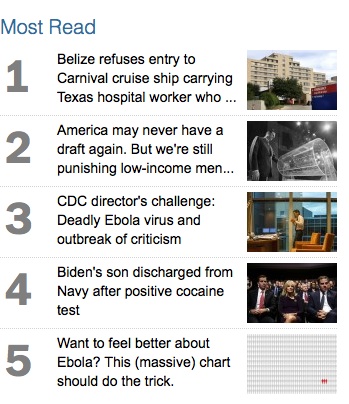
Of the five most read articles at the Washington Post this morning, three are about ebola.
Vox has 25 stories about ebola.


http://www.salon.com/2014/10/09/why_ebola_triggers_massive_right_wing_hysteria_partner/
Interesting analysis.
That said, I know plenty of liberals who have fears of contamination. The other day at work I filled my water bottle from the water fountain (or “bubbler” as they say here in this part of New England), and the friend I was walking with had a fit because she views it as a hotbed of germs. I’m surprised she ever lets me in her office. She’d really lose it if she knew I like to push the 5 second rule to 10 or 15 seconds. 😉
LikeLike
The thing about ebola is that there’s a “news you can use” aspect to it, which is going to drive up the readership.
There’s nothing I need to do about Biden’s son using cocaine or chemical weapons in Iraq.
The point has been made that the CDC’s “don’t worry be happy” approach to ebola actually makes people more nervous than they would be if the CDC seemed more actively engaged in containing it. (And why the heck was that Dallas hospital left to muddle along with an ebola patient by themselves? What is the Center for Disease Control for, anyway?)
This has the potential to be Obama’s Katrina moment.
If ebola reached our town (and we’re in day trip distance from Dallas), the most obvious measure for our family to take would be to take the 2-year-old out of parents’ day out. I love parents’ day out, but 2-year-olds and their diapers are a pretty obvious infection vector. Pulling the big kids out of school would be the next phase, but heck if I know when we’d be able to send them back.
Multiply this by thousands or millions of people making the exact same decisions that I am contemplating, and there’s the possibility for massive educational and economic disruption.
Oh, and come to think of it, if we have substantial numbers of health care providers quitting or pulling the scrub version of “the blue flu” in the face of an infectious disease that disproportionately kills health care workers, everybody is going to be up a creek. It’s also not at all unreasonable for doctors and nurses and other hospital employees to worry about going home and fatally infecting their loved ones.
LikeLike
And I don’t think I’m being that paranoid about school. Our school has a lot of medical families, so there’s a very obvious chain of infection from hypothetical ebola patient to classmate’s doctor or nurse parent to classmate to our kid.
LikeLike
I’ve been really surprised that none of the news sources I’ve encountered have yet mentioned the fallout that will happen if/when communities are asked to hole up and stay home in an effort to stop transmission of disease. The majority of USians have no paid leave—asking people to stay home is de-facto unemployment, albeit temporary. In a health crisis, will workers without paid leave be eligible for unemployment benefits? Going a week without pay would put most workers in real hardship. Will utilities, landlords, other debtors be mandated to forgive debt in recognition of the health emergency?
Most workers are already going to work sick because of the lack of paid sick leave combined with a need to pay bills. That isn’t going to change in the face of Ebola or anything else, because those bills aren’t going away and people still need the basics. They’re going to truck off to work and tell themselves it’s just the common cold until their symptoms increase to the point they can’t anymore—-just like they do now. And in most cases, they’re right–it is just a bad cold. Until it isn’t, and now everyone else at work is trucking along through the flu. Or worse.
LikeLike
Legally, can the CDC force a hospital to accept direct involvement of its staff? Especially in Texas, which has always been on the pickier side of things having to do with federalism? It’s pretty clear to me that Dallas Presby failed, but that the CDC failed is less obvious to me.
LikeLike
The infection rate at the Dallas hospital suggests to me that Ebola patients need to be treated in specialty wards. I’m not sure when this would kick in (presumably when Ebola is identified in a patient, so people will still need to be trained in Ebola procedures), but treating at a local hospital (and, I don’t know, but is the Dallas hospital a “ellis island” hospital — Abraham Verghese’s term for the inner city urban hospitals that treat everyone?).
LikeLike
You know, I hadn’t even thought about the fact that my sister is a nurse in a NYC area hospital. Hm. Still not going to worry too much, or more than I otherwise would have. Health care workers take risks with infectious diseases every day. Ebola isn’t more or less of a risk than a lot of stuff.
Again, I think it’s because contamination just isn’t a fear of mine.
LikeLike
“This has the potential to be Obama’s Katrina moment.”
Seriously? Only if 1500+ people die. How many different things have people been attributing as “the Katrina moment”?
I am surprisingly paranoid, in spite of my general opposition to paranoia for infectious diseases. I do think my paranoia is being fueled by CDC’s “don’t worry” attitude. They are worried about panic, and so are telling people not to worry, but in fact, they need to tell people the specific situations in which they should worry. As an example, if you have been exposed and are being monitored, you are not supposed to travel on commercial airlines (and long distance busses? or are those OK. How about taxis and public transportation?).
LikeLike
I think you can take Uber, because ride sharing isn’t a taxi.
LikeLike
Ha ha. And, of course, remaining vague means people will apply discriminatory rules, like not accepting a Uber passenger who is African, and speaks funny (i.e. with an accent), or, even more broadly, because they are African-American, or, potentially, because they’re brown, and brown people come from areas where there are diseases.
LikeLike
I am worried about health care personnel. I think in the initial stage of infectious diseases, the non-hands on people (the administrators, supervisors, etc.) say things like “proper procedures will ensure appropriate containment” and don’t take into account the facts on the ground. The presume that all procedures are followed to a T all the time. But, of course they’re not. In general, as a worker in the emergency room you are not encountering a deadly disease; you’re encountering a cold or some other disease you can shake off. You modify procedures accordingly.
I worked in labs where infection was a concern and saw procedures change pretty dramatically over the years. The potential infection agent was a deadly (10% survival rates), but not very communicable disease. When no infection had occurred for a number of years, people get sloppy. Then, a college student volunteering in a lab died. And everyone got more serious. The supervisors were still a bit sloppy, because they weren’t in contact nearly as frequently.
Ebola clearly requires pretty specific procedures (as did/does AIDS — health care personnel were at risk, there, too, though the risks were significantly different, and, I think, lower. A scholarship in the immunology department at one of my universities is in honor of a sister of a immunology prof, who was a nurse, and died of AIDS). I think, right now, the right procedure is to treat ebola patients in specialty wards.
LikeLike
Having experienced some reasonably major hospitalization about 4 years ago and seeing how hit & miss the protocols are for cDiff and MRSA, I’d stay away from hospitals as much as possible.
Staff have to suit up to go into isolation rooms but family members don’t have to – think of the public washrooms on the ward, the elevators and other common areas. No wonder both spread like crazy. Take a walk through an adult ward and see how many isolation rooms are signed cDiff or MRSA despite the claims that there isn’t an outbreak.
In other words, I don’t think there is a need for crazy paranoia but at the same time, they aren’t doing a great job of handling the existing infectious diseases. Hopefully the ebola freak out will motivate tighter protocols all around.
LikeLike
There are reasons why health care personnel, who will be touching and interacting with wounds and infections, would have different protocols than visitors for MRSa, cDiff. And, with any infection risk, you play the odds and come up with a balance, of odds, that doesn’t unduly inhibit everything else we want to do.
And each infectious agent has its own rules (the one I was trained to avoid required pretty specific contact for transmission, and, even then, its transmission rate was low). It’s hard to find the balance between reasonable precautions and paranoia, but health personnel (i.e. the CDC) have to release meaningful information to help people find the balance, or they will both under and over react.
LikeLike
“…is the Dallas hospital a “ellis island” hospital”
It’s a magnet for rich people, I know that. My division’s VP recently had a baby there. Not to say they don’t serve immigrants.
I would be very concerned if I were in Dallas with contact with the medical communities. Here in Massachusetts, I’m more concerned after watching Presby and the CDC make stupid mistakes than I was before.
“Legally, can the CDC force a hospital to accept direct involvement of its staff?”
I don’t know about legally, but hospitals have to submit to entities like the joint commission and departments of public health all the time. If the CDC had decided to step in, a hospital wouldn’t have much ground to push back.
I agree with bj, the CDC is spending too much time on “don’t panic” and not giving us good information. It just makes me worry that the CDC can’t do its job.
LikeLike
Hmh, another potential explanation for hospital related failure — a “rich person’s” hospital isn’t well suited to treat infectious diseases, either (because they aren’t used to encountering populations at risk).
LikeLike
Bought plane tickets to an academic conference in February and wondered whether all the planes in the US will still be flying in a few months. We’re a military community and I”m terrified that some soldier will bring it home to his family from Liberia, and then pass it on to my kids at school.
LikeLike
I think it’s also important to remember that none of Duncan’s immediately family and friends in the US caught the disease, despite living in close quarters with him while he was in various stages of the illness and being quarantined with his infected waste products. From what I gather, the contagiousness of the patient increases exponentially as the patient gets sicker. A corpse is basically radioactive, but a person displaying early symptoms is perfectly safe to be near. From what I’ve read, at early stages sweat and tears contain almost no virus. Duncan had two episodes in the hospital before his diagnosis when he was treated as just another patient and no precautions were taken. The first time, he wasn’t all that ill and thus not that contagious, but the second time he was quite sick, and from what I’ve read they think the nurses were infected after he was admitted but before he was diagnosed, when they were in close contact with his bodily fluids but not taking proper precautions. If the hospital had taken him seriously the first time, none of these infections would have happened.
My feeling is that we have two health systems, one for the insured and one for the uninsured. One is top notch, and the other probably ranks down among that of developing nations. Show up as a doctor with ebola and you get the best treatment in the world. Show up as an uninsured Liberian immigrant and you get discharged with antibiotics. I hope the publicity surrounding Duncan’s negligent noncare (which may have cost him his life, as ebola seems to be much more survivable if you start treatment with first symptoms) will lead to real healthcare reform.
LikeLike
No words.
LikeLike
I dunno, “Oh for fuck’s sake” seem like perfectly appropriate words.
LikeLike
Ebola has a 50 – 75% death rate. That means despite treatment, you are as likely to die as survive, no matter how good the medical care. At present, in Europe and the US, 4 have died, 5 have recovered, and 7 are in treatment. It seems to align with the odds. It’s an agonizing death.
I just finished _The Hot Zone_. I recommend it. The book depicts a distinct difference in the approaches taken to Ebola on the part of USAMRIID and the CDC. In _The Hot Zone_, the CDC head at the time (20 years ago) seems very nonchalant about how hard it might be to catch Ebola.
The USAMRIID was more…serious about infectious disease. I would not be surprised to learn that the attitudes are still present. I am glad to hear of a potential US Army “swat team” to care for Ebola cases.
Right now, from one Ebola patient cared for in a standard hospital, we have two new Ebola cases (so far.) That’s not a good mathematical trend. My friend, who’s married to a nurse, is livid about the lack of equipment on hand in US hospitals for nurses to provide care to Ebola victims safely. Her hospital has a steady stream of patients from Africa. We are not isolated.
One important point. _The Hot Zone_ covers the outbreak of Ebola Reston. That strain was deadly for monkeys, but did not seem to harm humans. However, the workers caring for the monkeys did catch it. There was (apparently) evidence that that strain of Eblola was airborne.
LikeLike
It’s certainly a good thing to worry about, but two people isn’t a trend and some perspective is in order. In U.S. alone, there something close to 100,000 deaths every year that are related to infections acquired in hospitals.
LikeLike
How many of those deaths are nurses dying from diseases caught in the course of their work? I can’t find any statistics online, which leads me to conclude it’s very, very low. And dying from MRSA or flu can’t be compared to dying from Ebola.
The people on the front lines are those who provide care. They are most likely to be splashed with vomit and explosive diarrhea from dying patients in seizures. It’s not really vomit and diarrhea in the last stages, though, but the patient’s liquefied gastro-intestinal tract.
The nurses’s union have spoken up in this state: http://www.bostonglobe.com/metro/2014/10/15/ebola/LhkBmkuYeG08RDpixPwC9I/story.html.
Do I believe managers, or nurses? I believe the nurses. Also, the equipment the nurses demonstrated to the press last week was laughably flimsy and did not cover much. It was nothing like the equipment one sees on African health workers (who have a high death rate.)
LikeLike
HIV: http://www.cdc.gov/hiv/risk/other/occupational.html
Hep C: http://www.ncbi.nlm.nih.gov/pubmed/7534324
Lots of stuff: http://wwwnc.cdc.gov/eid/article/11/7/pdfs/04-1038.pdf
LikeLike
Protecting healthcare workers in general and nurses specifically is great, but I don’t see that equipping every hospital in the U.S. to deal with Ebola is a reasonable way to do it any more than equipping every hospital in the U.S. as a first class trauma center would be reasonable.
Only specialized hospitals, which were set-up years ago, should be allowed to treat these cases.
LikeLike
@MH, assume a patient arrives at the ER with fever, nausea, vomiting, and red eyes. Disgnosis is easy (I’m not including early cases.). It’s not a specialized hospital. Transport must be arranged. There is a waiting time, in the best case scenario, while the specialized airplane, with crew, is dispatched.
Thus, every hospital must be able, at a minimum, to diagnose possible cases, and provide care until help arrives. That means an isolation room, and nursing personnel fully outfitted to deal with a late stage patient producing copious amounts of infectious material. You can’t leave them sitting in the ER waiting room, infecting passersby.
News reports posited the Ebola “swat” team should be (once trained and equipped) ready to go within 72 hours. That’s 3 days of nursing care, even at standard hospitals. Two nurses at all time, so they can monitor each other. Shifts round the clock.
This scenario assumes there is space in the specialized hospitals, and the specialized plane is available. Private plane owners will not be volunteering to provide transport. Taxis will not do. Ambulances aren’t presently set up for safe transport.
LikeLike
The nurses who got infected in Dallas weren’t the ones in the ER or just having passing contact. It was the ones providing direct care when the patient was at his most ill (and most contagious).
The 72 hours Doctor-Swat teams are additional protection. They are not supposed to be the
first response.
LikeLike
I’m not sure we’re seeing a 50% death rate in the West (n is small so it’s hard to discern a definitive pattern). The two Spanish missionaries were almost dead on arrival–one I think died the day of, and the other died almost shortly after arriving, so they should probably be excluded from the figures as they didn’t receive Western treatment. The Spanish nurse and NBC camera man have recovered and the first Dallas nurse is on the mend. No person who has received treatment in the West from onset of early symptoms has died. Duncan and a Sudanese UN peacekeeper have died, and Duncan only received treatment after the disease had progressed quite far. I’ve read figures predicting a mortality rate of around 33% in a developed country setting, which is high but not 70% high.
LikeLike
Ebola appears to be targeting those who hang out around Presbyterians. Which is sort of worrying, given that I’m down the street from a Presbyterian hospital, but sort of ironic given the Calvinism thing.
LikeLike