
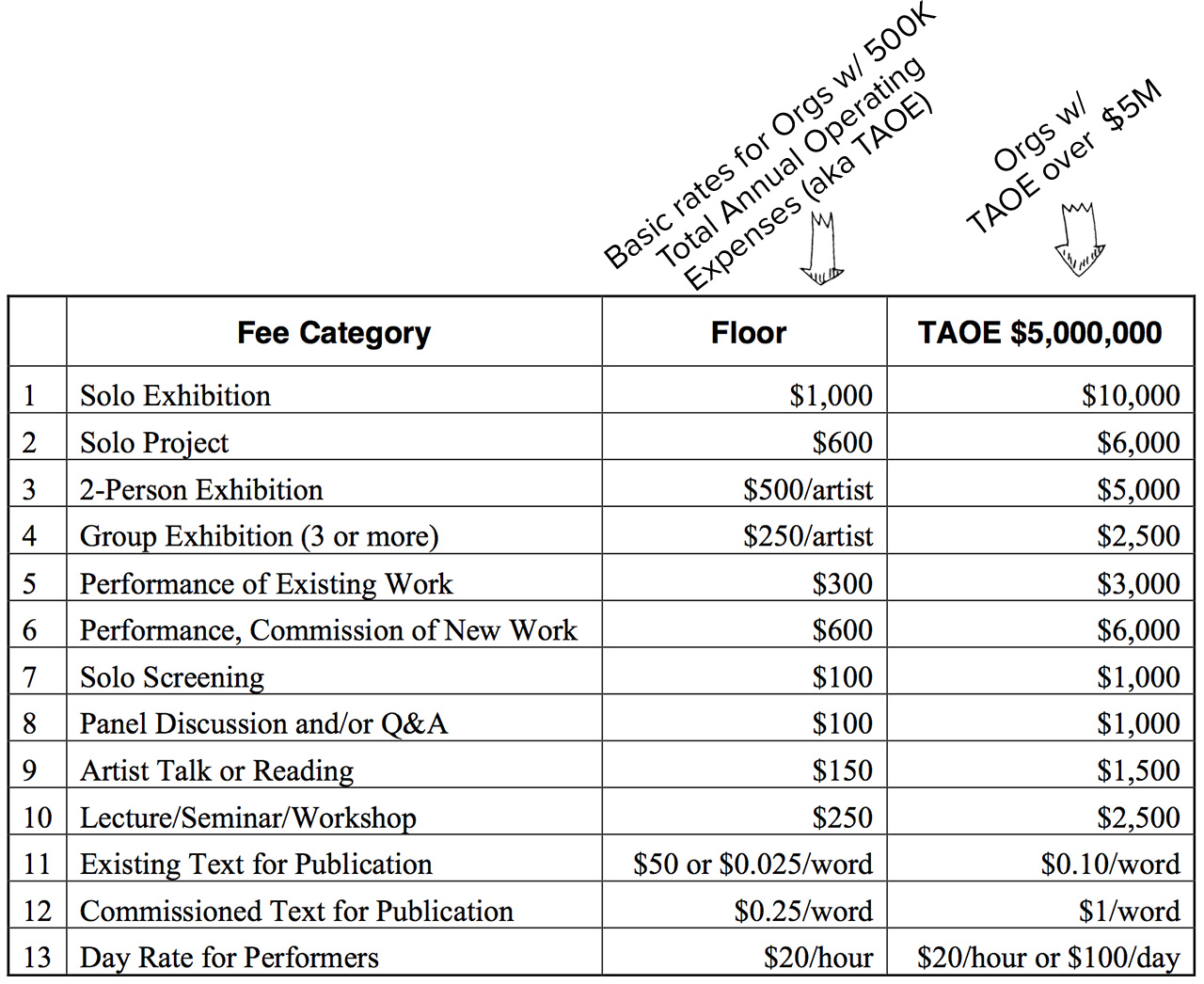
 An organization for artists, Working Artists and the Greater Economy (aka W.A.G.E), laid out a simple chart with fees that artists should expect for their work.
Imagine if writers and academics demanded compensation for every conference, every paper, every public talk. I wouldn’t be wealthy, but I would probably be less cranky.

 Apt. 11d
I’ve spent the last few classes teaching “Bartleby the Scrivener,” “Orientation,” by Daniel Orozco, , and a few episodes of “The Office” (“Did I Stutter” and “Office Olympics,” in case you’re wondering). We spent a lot of time discussing the nature of labor and the relationship between employers and employees, whether or not workers are treated as people with lives outside the office, whether or not people should be paid only for the time they work (just-in-time scheduling). I think trying to assign values to certain part-time activities has some sort of appeal, but is that the way we really want to organize the scheduling and pay of labor? If I was paid only for the time I worked, would I be typing this comment now? Or, would it be better for me to be paid for being in the office from 9 am to 8 pm today, even if there are 20 minute patches of time here and there where I’m not working, and what about the drive home and back in an hour so I can pick up my daughter from Model UN and bring her home then head back here for a meeting and a night class? How about the time it takes me to figure out precisely when exactly I am working or not working? Sorry–I do not want to go there.
LikeLike