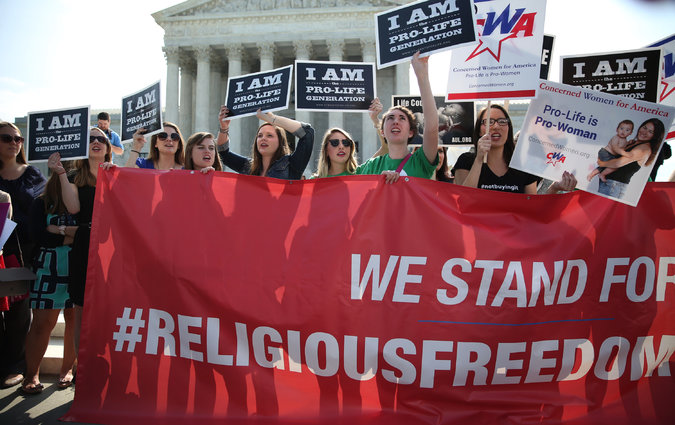
 The Supreme Court has ruled that the federal government cannot require that privately held companies provide contraception to their employees as part of their health insurance policies.
Talk about it.
UPDATE: ABC, TPM, the Atlantic,
UPDATE2: Megan,
Leave saving the world to the men? I don't think so.

Comments are closed.

 Apt. 11d
Shouldn’t we read the opinion first? (Unblogospheric notion.) Maybe this afternoon I’ll say something.
LikeLike
My gut reaction (not having read the decision) is Fine. Let’s just have single payer insurance guaranteed for everyone. More later once I’ve read it and/or informed analysis of it.
LikeLike
Can the north PLEASE secede? I wonder how much of this stuff would be a problem if our national politics did not include Oklahoma, Texas, or Arkansas.
LikeLike
Well, I’m planning on boycotting employers who deny health care to their workers, when I can.
This issue has come up in our state for a pharmacy, Bartell Drugs. The end result of the case was a settlement with the class of female employees, guaranteeing health care coverage. Bartell had also lost in court (in 2001, in district court case; the case was decided on gender equality grounds). Potentially the case would have been decided differently under this new Supreme court precedent (though the requirement under the ACA to provide health insurance might have played a rule in today’s ruling). But, in the case of Bartell, I’m guessing the settlement occurred because of consumer pressure.
LikeLike
It will be easier to boycott Hobby Lobby than B&H Photo.
LikeLike
I think my husband has paid for the salary of at least 1.5 B&H employees over the past 20 years from all his purchases.
LikeLike
Having now read the opinion and the dissent, I think that:
1. The Court was right to construe “person” to include corporations. That is simply the normal meaning of the word, in legal usage. And any other construction would produce a lot of litigation, given today’s legal universe. If corporations are excluded, what about partnerships? Tenancies-in-common? Limited partnerships? Limited liability partnerships? Business trusts? Limited liability companies? Interestingly, I would guess that the Justices and their clerks, who have collectively almost no experience in actually practicing law, are only vaguely aware of these issues.
2. HHS fatally weakened its case by allowing exemptions for some employers (i.e., basically, churches). Once the government did that, it was hard to justify not extending an exemption to for-profit corporations.
More generally, I predict that, given (i) the increasing reach of the regulatory state, (ii) the increasing prominence of cultural issues as points of political contention, and (iii) the militant secularism of most sectors of the policymaking elite, such cases will grow in number.
LikeLike
If corporations are excluded, what about partnerships? Tenancies-in-common? Limited partnerships? Limited liability partnerships? Business trusts? Limited liability companies?
Easy, peasy. They are all not people. People are people. Legal constructs are not people.
LikeLike
Interesting. So the Episcopal Church has no right to religious freedom, and the New York Times has no right to free speech? What about the marital community of my wife and myself? Do we have any rights?
LikeLike
Interesting. So the Episcopal Church has no right to religious freedom, and the New York Times has no right to free speech? What about the marital community of my wife and myself? Do we have any rights?
I didn’t say that churches and corporations have no protections. But what is a “church?” What is a “corporation?” What is a “marriage?” All these are legal constructs and so can have specific aspects of personhood assigned to them or denied them legislatively. They should, by themselves, have no constitutional protection.
The constitution applies to citizens. Individuals are citizens. Corporations are not citizens. Regardless of what this corrupted pro-corporation court says.
LikeLike
OK, so you are saying the New York Times has no CONSTITUTIONAL right to free speech? Just whatever free speech rights Congress wants to give them from time to time?
BTW, RFRA is not the Constitution. Congress wrote the statute and made it applicable to “persons.” Congress could amend the statute tomorrow and restrict it to natural persons, so it did not protect the religious freedom of churches or other corporations. It has nothing to do with the Supreme Court’s Constitutional jurisprudence.
LikeLike
OK, so you are saying the New York Times has no CONSTITUTIONAL right to free speech? Just whatever free speech rights Congress wants to give them from time to time?
The New York Times does not write or say anything. Everything they do is done by people and the people have a constitutional right to free speech. It is not more or less protected because they are paid by the Times and their words are printed on their paper.
In the current debased jurisprudence endorsed by the Supreme Court, corporations, legal constructs created for business purposes, have appropriated constitutional protections that should be reserved for individuals.
LikeLike
Does a corporation have a religion? If so, how do you demonstrate that? Does it go to church? Does it believe in God? If it’s by claiming the humans running the corporation have a religion therefore the corporation does too, then you’re collapsing the separateness of the corporation from the humans which run/own it. If you want to stand by this, then you better be prepared to defend eliminating personal immunity for corporate liability. I look forward to watching CEOs and Boards pay off corporate debts from their own pockets.
LikeLike
The religious corporation of which I am a member, though it owns a church building, hires a pastor, etc., does not itself go to church. Likewise, the corporation which publishes the New York Times does not itself have political views. Nonetheless, both corporations are protected by the First Amendment.
LikeLike
The problem at the root of this is the disturbing “corporations are people” idea that this supreme court has embraced. Unfortunately, we will either need to replace a justice or a “corporations aren’t people. people are people” amendment to reverse this abomination.
LikeLike
If corporations have no rights, that means that any time the people who work at the New York Times (a corporation with no rights) print something that annoys the government, the corporation can be fined (just as it can be fined for OSHA violations by an incompetent foreman), and forced to hand all over its corporate assets (they are not Constitutionally protected).
LikeLike
If a corporation is truly a person with all the constitutional rights a person has, then fining it for OSHA violations committed by an individual employee (a separate person) would violate its due process rights. So the corporation is not a person in the same way that the employee is a person.
As a legal construction, there are ways within this construction to address the liability issues you pose without extending the concept of citizenship to the corporation.
LikeLike
Huh? I guess you’ve never run a small business. If I have a restaurant which I operate as an individual on an unincorporated basis, and one of my employees doesn’t keep the kitchen floor clean, and a health inspector writes me up, I have to pay the fine, even though it was the fault of the employee. There’s no due process violation there.
Anyway, don’t switch the topic to OSHA. Face the consequences of your political choices, and say, “Yes, the government could take every single corporate asset of the New York Times, and drive it into bankruptcy, if the editorial expression of the individuals who work at the Times displeased those in authority.” Because that is what you are advocating.
LikeLike
Um, no. I am not arguing that corporations have no legal rights. I am arguing that their prerogatives can be safeguarded without implying that they are people, with religious consciences and the rights to participate in politics and the absolute protections our constitution grants to individual citizens. A viewpoint, I may add, that is not so outside the mainstream. In fact, four of the supreme court justices take just this point.
We will just have to agree to disagree on our opinion of the correct place of corporations in our society. I happen to think that yours is dangerous and pathological and look forward to the day when corporations are just contractual aggregations again and not considered “people.”
LikeLike
I like the idea that we try to make things work for religious people. I grew up a Quaker, though I have left, and I think the work the government did to find a way for pacifists not to be forced into combat, while scrutinizing them enough that shirkers had a hard time availing themselves, was a good thing. Similarly, I have sympathy for the folks who didn’t think they – opposed to gay marriage – should be required to sell him ‘n’ him, or her ‘n’ her, wedding cakes.
In the case of Hobby Lobby, it’s ridiculous on its face to think that this makes it difficult for employees to get contraceptive services. Contraceptive services are cheap. If it’s a big deal for Miss Fluke, she should go find a job with another company. Requiring their provision is mostly a way to punish people for having a belief system of which the New York Times disapproves.
LikeLike
The problem is that many women take the birth control pill for health reasons, for instance, anemia from excessive bleeding. 14% of women who take the pill do so for those reasons. Many teens take the pill for those reasons, even if they have never had sex and do not intend to have sex anytime soon. Sandra Fluke was actually discussing these sorts of cases in her presentation.
I understand there can be a medical exception to any rule that bans funding the pill, but as in the cases Fluke discussed, appeals that rely on those exceptions can be denied. The claim can be made that it’s really just for contraceptive purposes. Also, I am sure many women wouldn’t want their employers directly involved in assessing whether they are taking the pill for medical reasons or not. It’s none of their employer’s business. But I’m sure these companies will be reluctant to leave the decisionmaking to the doctors (I hope I’m wrong) because they’ll worry that there’s too much room for subjectivity and the doctors will just claim the problems are medical (just as everyone thinks they subscribe marijuana to anyone who wants it in California).
Finally, not all versions of the pill are cheap, and certain ones may be required if you are taking the pill for health reasons.
LikeLike
Prescribe marijuana, that is.
LikeLike
A useful short discussion of the opinion is here:
http://leiterlawschool.typepad.com/leiter/2014/06/shorter-hobby-lobby.html
(somewhat misleadingly, the most useful part is in the update “somewhat longer” version.) It sums up the most important conclusions in a way that should be accessible to a non-lawyer.
I don’t 100% agree w/ Y81’s analysis on corporations as people, but think it is at least largely right for many cases. For a very interesting discussion as to why it might not be right in this particular case (and why it’s _more_ problematic for at least some closely held corporations) see here:
http://bleedingheartlibertarians.com/2014/06/hobby-lobby-and-soylent-green/
LikeLike
I have to say, I am finding the @scotusblog mixup to be hilarious. No greater proof that stupidity exists on both sides of the aisle.
http://www.huffingtonpost.com/2014/06/30/scotusblog-hobby-lobby-ruling_n_5544977.html
LikeLike
Well – I haven’t read every response here but perhaps it’s high time to consider that it’s a bit of a problem to put the onus for any form of health insurance on employers, private or not, as opposed to the federal government that makes the laws about what health insurance ought to cover (and incidentally also collects taxes).
LikeLike
One of my favorite bloggers posted, in response to ‘corporate identity’, MacLeish:
CORPORATE ENTITY
The Oklahoma Ligno and Lithograph Co.
Of Maine doing business in Delaware, Tennessee,
Missouri, Montana, Ohio and Idaho,
With a corporate existance distinct from that of the
Secretary, Treasurer, President, Directors or
Majority stockholders, being empowered to acquire
As principal, agent, trustee, licensee, licensor,
Any or all, in part or in parts or entire –
Etchings, impressions, engravings, engravures, prints,
Paintings, oil-paintings, canvases, portraits, vignettes,
Tableaux, ceramics, relievos, insculptures, tints,
Art-treasures or master-pieces, complete or in sets –
The Oklahoma Ligno and Lithograph Co.
Weeps at a nude by Michelangelo.
LikeLike
Macleish is evidently joking, but when Daniel Webster defended the Dartmouth College corporate charter with his famous peroration of “it is a small college yet there are those who love it,”
LikeLike
O deal, the comment page crashed and this comment got sent in the middle. My point is that Daniel Webster was not joking: corporate charters can arouse strong emotions.
LikeLike
“Congress shall make no law respecting an establishment of religion, or prohibiting the free exercise thereof; or abridging the freedom of speech, or of the press; or the right of the people peaceably to assemble, and to petition the Government for a redress of grievances.”
I think there is another clause in the first amendment that would apply to the corporation known as The New York Times.
LikeLike
Religious people have sometimes had to make a principled decision not to work for a corporation which might uphold a set of beliefs which differ from theirs — My dad is a Catholic doctor who asked for a religious exemption so that he wouldn’t have to perform abortions as part of his residency. If he hadn’t been granted it he would likely have had to find a different residency. If my dad was able to realize that sometimes a corporation isn’t going to be able to accomodate your beliefs and therefore you might have to work somewhere else, why couldn’t a secular person be asked to do the same thing?
It seems like a double standard to say that corporations should have to accomodate the wishes of secular people all the time, but that the only choice a religious person would have would be to work somewhere else.
LikeLike
Scott Lemieux explains what’s the what:
“Your employer does not receive any tax benefits for compensating you with Hummel figurines or automobiles instead of wages. It does, however, get tax benefits for compensating you with health insurance instead of wages. (It would be nice if health insurance were decoupled from employment entirely, but needless to say this isn’t the alternative preferred by conservatives like McArdle.) Because of this, the insurance provided in lieu of wages actually has to cover things. After the ACA was enacted, contraception for women became one of those things. Women compensated by employers, in other words, have a statutory right to have contraception covered if they choose to use it. This is not, as McArdle suggests, a “side payment.” It’s part of an employee’s compensation package. What Hobby Lobby wants is to pocket the tax benefits for compensating their employees in health insurance but not to provide the full benefits to their female employees.”
LikeLike
I don’t think that’s accurate at all–the tax benefit is on the employee side. The employer would get the same tax deduction for your compensation whether it is in cash or Hummel figurines or health insurance. But the employee has to pay tax on cash or Hummel figurines, whereas he or she does not have to pay tax on health insurance.
Under Obamacare, there is a new employer penalty for not providing health insurance. If avoiding that penalty is the “benefit” that Lemieux, then it is true that there is an employer benefit to providing health insurance, but of course that penalty is discussed at length in the Supreme Court opinion. (The government suggested that Hobby Lobby could avoid any problems by not providing health insurance at all.)
Scott Lemieux is not, incidentally, a lawyer, so you shouldn’t go to him for tax advice.
LikeLike
Similarly, if I don’t want to become a vegetarian and stop wearing leather, I can’t actually work for PETA. Should we demand that PETA accomodate people who want to eat meat and wear leather and provide meat in the cafeteria and hamburgers at the company picnic? If you remove the word ‘religion’ from the argument, it seems like we allow corporations to have their own corporate practices all the time — people who don’t like it don’t work there. (You can’t be a drug user and have a security clearance, You don’t have a right to use drugs and work for the government.)
LikeLike