
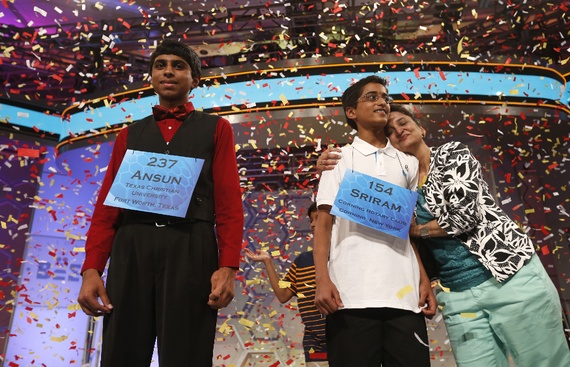
 In the Atlantic, Sameer Pandya writes about how the National Spelling Bee confirms racial prejudices about Indian Americans.
If you are an Indian American obsessed with American sports, occasions for ethnic fandom have been scant at best. After the two Vijays—the tennis player Amritraj and the golfer Singh—who do we really have?
And so it is only with a slight hint of irony that I watch the Scripps National Spelling Bee year after year with great pleasure and anticipation. With the crowning of the co-winners Sriram Hathwar and Ansun Sujoe late last month, it makes seven straight years that Indian Americans have won the national bee. From my place of lack, this is nearly as exciting as living in Chicago in the Jordan era, or being a New Yorker when Jeter, Posada, Pettitte, and Mo were young and winning rings.
When I watch the Spelling Bee, I’m on the lookout for kids with Asperger’s, not race. We all have our own lens, I suppose.
While my immediate family is a European mix, the larger extended family has roots outside Italy, Ireland, and Germany. My sister-in-law is African-American. My cousin-in-law is Puerto-Rican. My uncle is Indian. My cousins, who are more like my siblings, are Indian and Italian. My godson is Indian, Italian, and Puerto-Rican. We’re a hodge-podge of colors and backgrounds, but with a huge showing of Indian Americans. So, Pandya’s argument that people watch the Spelling Bee to gawk at the Indian freaks is very disturbing.

 Apt. 11d
I’m going to continue my policy of ignoring spelling bees, but now I have a new reason.
LikeLike
I learned from a Slate article (in 2010 that the North South Foundation, with its string of academic contests for Indian-Americans plays a big role in training the contestants. Aside from the cultural issues, I think that what the results, the current cultural domination show, and, interestingly, this year’s tie show is that there are certain human skills that can be trained nearly to perfection, given a set of characteristics available in a fairly broad swathe of the population. In the case of extreme spelling, the traits needed are good memory skills and perseverance. Combine that with training and you can teach a number of people to do extremely well at the skill. Then, cultural dominance is explained by those who are trained, and the expertise in training that arises.
(My kids refuse to become trained spellers, though they did both want to win their 4th grade class spelling bees, and win the bouncy ball, and both did).
LikeLike
Our C was second at our school-wide bee (first was a South Asian–surprise) this year, went to the regional spelling bee (which was conveniently in our city), and came in about eighth out of about 15. Crushing! But the goodie bag that all of the participants got was fantastic (including a frozen yogurt gift card), and C recovered very well as she picked through the loot. The South Asian kid from school got third at the regional bee, and first and second were taken by a white sister and brother from a suburban public school. Our C has one more year of eligibility, I believe.
C was mainly on her own with prepping and didn’t do more than about a week. On the way to the bee, I was quizzing her on Japanese origin words, which are almost all simple and phonetic. C found it a big confidence-builder, and quite a few of the Japanese ones showed up at the bee (for example–hibachi). The Dutch origin words on the list were terrible and fortunately did not show up at the bee.
I think you get the biggest return on time investment learning the spelling conventions for words borrowed from foreign languages.
LikeLike
Yup. I’ve heard it referred to as the Aspie Olympics! Not that that would be a bad thing, mind you . . .
LikeLike
“So, Pandya’s argument that people watch the Spelling Bee to gawk at the Indian freaks is very disturbing”.
I read something completely different in her article. She’s lifting the curtain a bit to reveal the pride felt as a member of a subordinate group when anyone from your group achieves something.
LikeLike
One of my children is a great speller. He thinks quickly under pressure. However, spelling very well is a skill with limited career potential. When was the last time you needed someone to spell a word for you? Never? (With the obvious exception of being too lazy to get up from the chair to find a dictionary or use a computer. But not an obvious road to paying the mortgage.)
Competition is interesting. I find intellectual competitions more interesting than athletic competitions. I recommend the movie Spellbound, about the national spelling bee before it got hip. Also, “Hard Problems,” about the 2006 US IMO team. And, “Beautiful Young Minds,” about the British IMO team, also in 2006. by the way, the British team was presented in BYM as significantly more on the spectrum.
We also liked “Word Wars,” about Scrabble competitions.
I don’t think people watch to see the “Indian freaks.” I think they watch to see a competition; Indian children are currently often in the finals. This I would put at the feet of a temporary tiger-parenting fad in the Indian parent community. I gather quite a few Chinese parents love piano competitions.
Another great competition documentary: “A Surprise in Texas,” about the 2009 Van Cliburn competition.
People love competition. The National Dog Show pulls about 20x more television viewers than the spelling bee.
LikeLike
I made it to state in the National Geography Bee in middle school. I “won” a fanny pack and matching t-shirt. At least I was cool enough to realize that wearing the fanny pack to school was instant social death.
LikeLike