
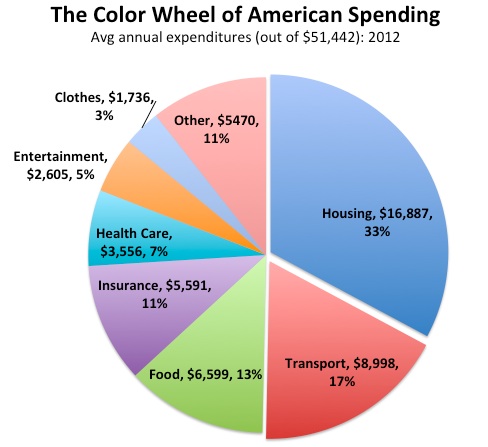
I’m strangely fascinated with Derek Thompson’s spending charts. Derek explains that Americans spend most of their money on housing. Transportation comes next. Then food. This spending pattern is mostly consistent among rich and poor in the US.
People in other nations have different spending priorities. The US spends way more on housing and transportation than Canadians, the British, and the Japanese.
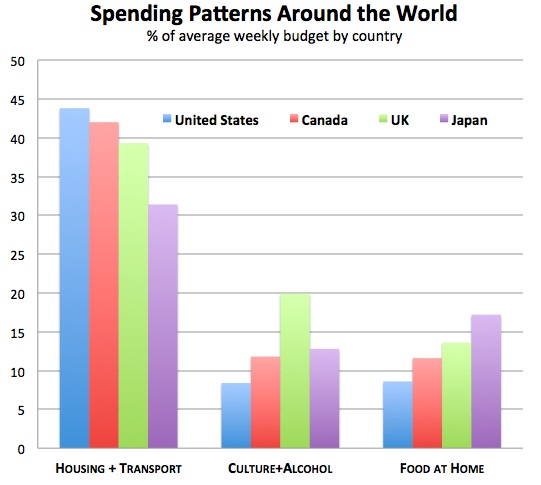
What’s up with that? Are Americans horrible suburbanites who love their big screen TVs and gas guzzling SUVs with cup holders? Oh probably. But Americans are also stuck with a decentralized education system that doesn’t exist in Canada, Britain, and Japan. People spend more on housing in order to get access to better schools. It is impossible to separate housing costs and schooling costs.
Derek thinks that perhaps this trend will fade.
Imagine what would happen if we didn’t spend $1 in $2 on houses and cars. It would be rocky for the real estate and auto industries who have come to rely on a steady stream of spending. But it would leave a lot of money left over other stuff—like smartphones, and dinners out with friends, and shoes whose fanciness belies our income level. This isn’t a vision of the future. It’s a description of the way a lot of young people live today, particularly educated twentysomethings who’ve moved to urban light areas (e.g.: newer suburbs within commuting distance of the city proper, like Arlington, Va.) where they can save on real estate, take public transit, and preserve enough of their lowish salaries to cobble together a connected and fairly social life outside work, if they have it.
And then those 20-somethings will get married, have kids, and move to the suburbs, just like the rest of us idiots, because they will freak out about the bad schools in urban areas.
Want to change spending patterns? Change our system of education.

 Apt. 11d
People save on real estate in Arlington, VA? What is he smoking?
LikeLike
That jumped out at me, too.
Holy cow, that was dumb.
I had some friends who lived in Arlington when we were in DC. They had a lovely one-bedroom condo, which got pretty tight by the time they had three kids.
LikeLike
Why do we want to change spending patters? What is the ideal? More on food? Because that would make the US look more like Europe. Why would that be desirable?
LikeLike
I would love to spend more money on culture and alcohol. Except no culture.
LikeLike
I’m pretty sure beer is a culture, no?
LikeLike
I can’t figure those charts out – according to the pie chart we spend 50% on housing +transportation (annual). Then the weekly percentage shows 43-44%? I can’t figure out what culture and alcohol are supposed to be from the first chart – entertainment + what?.
MH – No doubt Europe spends more on alcohol, in part, because of the higher taxes. But, if the higher spending isn’t due to taxes, do we want to spend more on alcohol? I don’t think we want to develop “chav culture” here. What is considered culture? Soccer, plays? The charts plus the live in Arlington because it is less expensive (NOT) is just weird.
LikeLike
For one reason, the spending on housing is incredibly distorted by government policy (both at the state/local level with restrictive zoning and at the federal level with tax incentives), and if we’re picking things to have the government push spending into, massive empty houses ought to be low on the list.
LikeLike
European policy also distorts housing. It isn’t an American thing.
LikeLike
Yeah, the analysis seems kind of silly, and driven by the ability to make cute pie charts. What should that distribution look like? Ours has much less spending on transportation and less on housing, but much more on education and travel. I hate spending money on transportation, since I dislike driving and don’t get any particular pleasure out of cars, so that looks about right to me. Also, our housing spending is probably even lower than it appears on my pie charts, since it includes our mortgage payments, without correcting for the increase in our equity.
LikeLike
bj said:
“Ours has much less spending on transportation and less on housing, but much more on education and travel.”
We also spend way less on transportation and somewhat less on housing. Our education expenses are several multiples of our transportation expenses.
LikeLike
This is what happens when 20-somethings write and edit all the online journals. They believe that we SHOULD spend our money their way – shoes and entertainment. I don’t know. I think I SHOULD spend my money on my kids (housing, aka school) and don’t really care what other people spend their money on. They can spend it on whatever they like (as long as it isn’t student loans).
LikeLike
“This is what happens when 20-somethings write and edit all the online journals.”
Amen to that.
Oh, the whining that will ensue when they figure out how much a 3-bedroom home in Northern Virginia costs!
(I once house-hunted in Alexandria probably around 2006. I was delighted to find a house in Alexandria near the metro for $399k. I was much less delighted to discover that 1) it was in the hood and 2) the view from the front yard was of the concrete wall of the metro line). There was no line of houses on the facing side of the street–it was just concrete wall (with, if memory serves, barbed wire on the top). Classy!
LikeLike
You might like Noah Cicero’s “The Insurgent”
LikeLike
As your own private expert on Arlington, Va, I am with Tulip. If he is that wrong about what Arlington costs, can you trust the rest of what he is saying?
LikeLike
I can’t get past the idea that he thinks Arlington is less expensive. Than where? Not DC, not Alexandria, not Rockville or Bethesda.
LikeLike
Yes, and I have no desire to spend more on shoes. But maybe we would spend more of the leftovers on savings (for retirement) and social safety nets.
Maybe his comparison is Manhattan.
LikeLike
And more on Smart Phones? Why?
LikeLike
Smartphones are great. They make riding the bus possible and thus keep transportation expenses low.
LikeLike
But aren’t we all spending more or less what we regard to be an appropriate amount on that sort of thing already?
I understand why you’d want one, but I don’t understand why you’d need more.
LikeLike
Does transport include air travel, business travel, commuting and private life?
For many couples between 30–50, with children, the family home is their largest asset.
We also encourage young adults not to live with parents. Other countries have very different patterns. If you live with your parents, you aren’t spending for housing .
http://www.craigwilly.info/2013/08/25/young-adults-living-with-their-parents-an-international-comparison
LikeLike
It’s been 20 years since I lived in Arlington as a 20-something, but I remember paying MORE to live there than in my apt.in DC. The only way it was less was if one was far from the metro. (but then you’d need a car…)
As for the spending charts – I just checked ours in Mint. Our food and our housing costs are basically equal every month. We’re in the midwest now, so housing may be less than the national average. We also chose to live in a small older house – we are not McMansion types. We really like good food, and we cook a lot. One cool thing about Madison is that it’s really easy to personally know the people who grow your veggies, or who process your milk and your meat. I’ll pay more to get milk delivered and chat with the farmer or meat guy at the weekly farmer’s market. (Although regularly knowing the name of the cow we are eating for dinner has turned one of my kids vegetarian…)
LikeLike
It’s the transportation costs that seem really high. They are split from housing in the pie chart that describes US spending but then lumped together for the comparison to other counties. I’m curious to know how just transportation costs compare to other countries and if that is where the real difference is.
LikeLike
Would that include the fact that the average family in the US has two cars if they have two jobs, and probably even if they don’t? I know a lot of european families that have one car and the other spouse often takes public transportation, bikes or walks. (And public transport was often, until recently, subsidized in Europe.)
Also, aren’t all public schools in europe roughly equal — really general statement, I know — but in the US, as laura mentioned, people pay a lot more for a better school district. I thought of that as kind of an American thing.
LikeLike
It looks to me like the UK is giving us all the finger because we don’t hang out with them at the pub.
LikeLike
No mortgage interest deduction on income taxes here in Canada. That, and some other financial policies, probably tweaks our scale a bit down as shown there. Otherwise the housing cultures and range of costs (high in and around the big cities, high for premium single-family homes) is probably pretty comparable
I’m assuming utilities get rolled in under housing costs because I don’t see them elsewhere on the pie chart. Climate and the cost of utilities, as well as the size of average homes & their energy footprint, these might all be elements that further complicate the North American market.
LikeLike
With regard to transportation, I feel like the American family vehicle is treated as a sort of house-on-wheels–it’s almost an extension of the family home.
LikeLike
Canada and the US are really pretty close. Japan is well known for being a country with sky high real estate prices that drive children to live with parents until they’re much older relative to Americans moving out. I’m not surprised that the result is a net reduction in housing spending. Come to think of it, that may answer the whole question. Outside of a few high cost areas (which Canada, Japan and the UK all have too) housing is really cheap in the US. For not that much money you can get a lot of space. It could easily be a simple substitution effect. Cheaper housing means buying more (as a substitute for other things you might like, such as food, shoes, smart phones, etc.) and the net result is an increase in the proportion of the budget spent on that.
LikeLike