
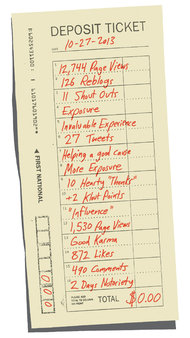
 Over the weekend, about a dozen friends sent me a link to an article in the Times. In this front page article in the Week in Review, a writer complains about being approached by editors to write for free in exchange for “exposure.” I guess I’ve been bitching a lot lately about the lousy money in freelance writing.
I’m perfectly willing to make crap money for my work. Because of family demands, I know that I’m not an ideal worker. I have to work around parent-teacher conferences and dentist appointments. But when the money went from crap to crappier in the past few months, I decided to rethink my efforts.
Why is the pay for words so terrible and getting more terrible?
You, consumers of information, are in the golden age. The Atlantic, The New Republic, Slate, Salon, the Daily Beast (which is wobbling, but still alive), Forbes, Business Insider, Bloomberg, the New York Times, Huff Post all have thousands of original articles and blog posts every day. And a good number of those articles are well-written, thoughtful, and informative. If you miss an article, you can go to Twitter and Facebook to see what’s the topic du jour.
There are more writers then ever before. The writers aren’t just people who write “writer” down on their IRS form. The writers are professors who have decided that they want to be public intellectuals, public policy directors who want more attention for their pet project, and even suburban housewives whose family demands have curtailed other career options. These intruders have other sources of income and happily exchange their words for influence.
The problem isn’t the demand. It’s the supply. There are too many venues, too many writers, all dividing up the little pool of money from advertisers. Paid subscribers are as quaint as my Dire Straits album.
In some ways, it’s a good time to write. There are dozens of venues for me to write about parenting or politics or education policy or whatever I choose. These editors are looking for good content to fill their quota. They never know which article will go viral, so they will take a shot on anybody, even middle aged women writing in the basement of a suburban split level.
I excel at working in prestigious fields that pay little money. Hello, Adjunct Professor salaries! I have endless bragging rights at my high school reunions, but my social security statements are embarassing. I think I need rehab.

 Apt. 11d
Do you have interest or skill in technical writing? I know a few technical writers who work as consultants and are able to make a decent living out of it. Establishing yourself is the hard part and you’d really need to work your relationships and contacts to get an “in” but once you’ve proven that you’re competent I think you’ll find no shortage of work.
LikeLike
There are a lot of fields where some people make a living, but it is very difficult. Two that come to mind (because they are interests of mine) are equestrianism and genealogy. Writing (or at least nonfiction writing about public policy) is apparently also one of those fields.
LikeLike
Anonymous above is me. (I don’t know why the comments page ate my identity.)
LikeLike
I don’t think this is all that new or actually driven by the internet. My brother used to get paid in magazine copies back in the late 1980s and early 1990s.
LikeLike
Conor Sen tweeted yesterday: “Print advertising used to be such a good business that writers mistakenly thought it was their work that was valuable.”
LikeLike
Conor Sen sounds like an asshole. It’s correct to say that certain types of writing had a greater value when tied to print advertising, but the value of nearly everything is contextual.
LikeLike
Two examples come to mind:
1. Playboy
2. National Geographic.
LikeLike
That’s not what I meant. I mean that writers’ work was valuable in a situation where print advertising is the best (or only, prior to 1920) game in town for getting your message across. It wasn’t something you could separate as if it were an accident.
LikeLike
Here’s what you could do: a MOOC (or something like that) that helps low-income students apply to college.
http://chronicle.com/article/A-MOOC-That-Would-Make-a-Real/142565/
I get paid $200 for a guest lecture/sermon at the local UU, which might take me a few hours to prepare – though I could totally ad lib it – but $0 for an article in a prestigious journal that I’ve spent literally hundreds of hours on. (And yes, it’s part of my job, but it’s part that I could pretty much bail on now that I have tenure at a teaching-focused institution.)
LikeLike
Got a royalty statement for an academic book of mine recently. Ninety one dollars! Lots of laughter in our house about how once a year I can take everybody out to dinner, but can’t actually afford to feed them every day. Actually not sure how funny that is.
I wonder if economists have written at all about the price of content. It appears that if you have a cat that does something cute and you put it on youtube you can get tens of thousands of dollars if you can convince a million people to click on it — but if you write something brilliant, you don’t get paid in the same way.
LikeLike
Last year my husband got a statement from a publisher. I forget how this happened exactly (some sort of thing with returned books from stores, or something like that), but he had negative sales on that particular title.
LikeLike
Laura – something you clearly care a lot about and have spent great effort on is special ed, and the balancing of rights there. It’s huge everywhere: http://www.washingtonpost.com/local/education/special-education-fights-pit-parents-against-montgomery-county/2013/11/02/9b470ede-10e5-11e3-b4cb-fd7ce041d814_story.html?hpid=z3. Can you find a perch from which to have input there? A legislative committee in Trenton? Some foundation? An administrator job in the local schools, making matches between kids and programs?
LikeLike