
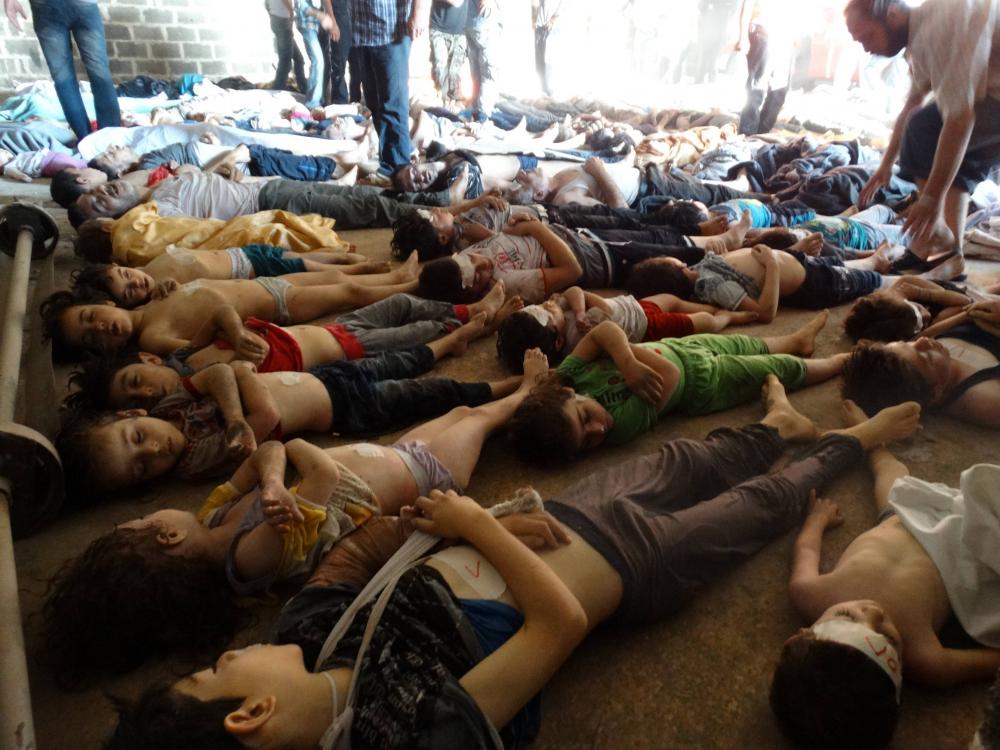
I look at pictures of children sick or dead from chemical weapons in Syria, and I want to hurt someone. I mean I want to personally punch someone in the face.
But do I really want to commit billions of dollars to another war? Do I believe that we can retaliate in a way that will have no dead American soldiers and won’t lead to long, protracted, unwinnable pit of pain?
I’m not sure. Open thread.

 Apt. 11d
Sure we can. We can poke Assad in the eye with some cruise missiles with little risk of dead American soldiers. This would enforce the norm against chemical weapons use and it sure won’t cost a billion dollars. If we later decide to get more involved, that is its own decision.
On the other hand this would mean aligning ourselves with some people who sure don’t have our interests at heart. And the likely persecution of Syrian Christians under an ascendant Islamist regime is something that greatly troubles me.
LikeLike
How does sending in some cruise missiles that are going to cause maybe a few hundred deaths in the midst of a war that has seen over 100,000 dead already going to enforce a norm?
LikeLike
Because it indicates the will of the most powerful actor, i.e. the United States. It indicates a willingness on the part of the US to escalate in the event of more systematic chemical weapon usage. And the ability of the US to escalate has no meaningful ceiling.
LikeLike
All the talk about how small the action will be very clearly indicates an unwillingness or inability to take meaningful action. I don’t see any good choices, but that’s no reason to pretend lobbing a few bombs does anything. Any action that doesn’t actually weaken Assad isn’t going to deter him or any future chemical weapon-holding dictators.
LikeLike
Agreed. The delay and debate have undermined deterrence, to the point where the “shot across the bow” is not likely to be taken as an indication of willingness to escalate but instead as a ceiling on willingness to escalate.
I don’t have a strong position in this debate. It seems that the window of opportunity for effective action has closed as the delay and debate have engendered the doubts about the deterrent value of any action.
LikeLike
Tell your congressional representatives to vote “no.”
LikeLike
“Any action that doesn’t actually weaken Assad isn’t going to deter him or any future chemical weapon-holding dictators.”
It is also to be noted that any successful action probably encourages dictators to develop even stronger weapons (i.e. nuclear). I’m not sure how and why Qaddafi backed down in Libya — my guess is that there was some form of pressure from friends rather than enemies, but haven’t read anything at all about the process.
I am not a pacificist and the specter of non-interference always haunts my min: “We must take sides. Neutrality helps the oppressor, never the victim. Silence encourages the tormentor, never the tormented. Sometimes we must interfere . . . ” (Wiesel).
But when we interfere, decide to kill people, we have to have a goal and then we have to be prepared to follow through until our goal is reached. I don’t think we have the will to do that in Syria.
LikeLike
“I am not a pacificist and the specter of non-interference always haunts my min: “We must take sides. Neutrality helps the oppressor, never the victim. Silence encourages the tormentor, never the tormented. Sometimes we must interfere . . . ” (Wiesel).”
That quote assumes that there is A) an oppressor and B) a victim and that the roles are unchangeable, whereas in many cases, yesterday’s victim will be today’s oppressor, given the opportunity.
“But when we interfere, decide to kill people, we have to have a goal and then we have to be prepared to follow through until our goal is reached. I don’t think we have the will to do that in Syria.”
Right. It has been demonstrated pretty much to the point of tedium that it is not possible to win a war from the air with conventional weapons (see WWII Germany, Britain, Japan and Vietnam). GWB’s wars were premised on the idea that if we wish to be involved in the Middle East and the Islamic world, we cannot be simply dealing death from the skies–there has to be 1) involvement on the ground (to take territory and build relationships) and 2) a constructive element. That turned out to be a lot harder than GWB’s administration thought it would be, but it is just as true as it was before the Iraq war that it is not possible to win a war from the air and install a functioning civil society from 35,000 feet up.
It is interesting to reflect on how Syria is in a number of ways a sort of mini-Iraq. You have the threatened religious minorities who formerly had the protection of the dictator and the use of chemical weapons (Saddam Hussein gassed thousands of Kurds to death in the 1980s), and I’m sure other similarities that would leap to the mind of a more informed person.
Obama came to prominence largely as a dove. What happened to him? Why doesn’t he see the similarities with the Iraq War, or see how complicated things have been in Libya and Egypt? Does he think that just not being GWB is good enough to protect him from bad outcomes?
LikeLike
And for that matter, whatever happened to “smart diplomacy”? That used to be an early Obama watchwords. I was just googling “smart diplomacy” and nearly all of the recent references are sarcastic.
LikeLike