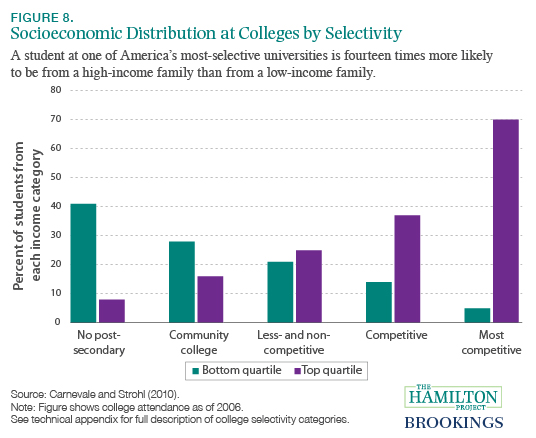
 Brookings has a nice report with very pretty charts that present a depressing picture about the relationship between social mobility and education.
Social Mobility and Education

Leave saving the world to the men? I don't think so.
Brookings has a nice report with very pretty charts that present a depressing picture about the relationship between social mobility and education.
Comments are closed.

 Apt. 11d
That report is kind of depressing, not least because the authors’ answer seems to be: what we are doing doesn’t work; therefore we must do it more and harder.
Here’s what I would like to know: as I understand, in many (most?) European countries, higher education is provided at state expense, but colleges are still stratified in terms of quality. What does the socio-economic portrait of those universities look like? E.g., are Oxford and Cambridge (or Uppsala and Stockholm) as dominated by children of the upper middle class as Harvard and Yale?
(Note that we have drifted back from the McDonald’s workers to our real interest, ourselves.)
LikeLike
I think this article: http://www.ox.ac.uk/media/news_releases_for_journalists/110311.html suggests that Oxford is doing better than the US “Elites”, with about 13% coming from the bottom quintile (income of around 25K pounds). In the Brookings document, the US “most competitive” schools are at about 5% from the bottom quintile.
Of course, there’s lots of categorization going on here which might not result in equivalence (does oxford = “most competitive” & what are the differences in characteristics of the bottom quintile in UK v the US). But the data might provide some fodder for consideration of the different educational systems. Would be interesting to see what the income level distribution is in the more purely test based systems in Asia, too.
LikeLike
Looking over the “most competitive” description, I suspect this includes a much broader category of schools than Oxford (i.e. Emory, Notre Dame) are examples.
But, this graph suggests that Harvard does more poorly than Oxford, too
http://www.fao.fas.harvard.edu/icb/icb.do?keyword=k51861&pageid=icb.page246751
(with about 3% of students w/ family incomes less than 20K, which is near the 25% in the US) (but, maybe better than the other “competitive” universities).
The schools are twisting numbers to suggest they are accessible, though, so we’d need to dig deeper to parse out the details.
LikeLike
Very impressive, bj, but where’s the report on Uppsala?
LikeLike
I think geography enters into this. The most competitive US schools are literally thousands of miles away from much of the rest of the country while Oxford is only a six hour drive from Edinburgh. I’m sure that feels very far away to residents of the UK, but for comparison, my hometown in WA is an 8-hour drive from my mom’s home town in WA and that’s all in the same state. It makes a difference when everything is so tidy and compact. There is a relationship between social mobility and just plain mobility.
It is a big pain to have to travel to the other side of the continent to go to school when what you’d really like to do is stay close enough to come home for the weekend and see your family and your dog and your boyfriend.
LikeLike
I was just playing with Google Maps and it turns out that my hometown in WA is 3200+ miles and 47 hours of driving away from Harvard, MA.
LikeLike
I’m not sure what geography would have to do with it. Even if Yale drew most of its students from southern New England, couldn’t you still validly compare their socioeconomic distribution with that of Oxford students? If significant numbers of poor people in England go to Oxford (which I’m not sure is true, but let that go for now), and very few poor people from Connecticut go to Yale, doesn’t that tell you something?
LikeLike
http://campaignstops.blogs.nytimes.com/2012/03/12/the-reproduction-of-privilege/
more info on “most competitive”
http://www.nytimes.com/interactive/2013/04/04/business/economy/economix-selectivity-table.html
(Whitman is WA’s only “1” category school; Gonzaga & U Puget Sound at 3).
LikeLike
On the geography question, it might matter to the extent that low incomes are unequally distributed across the US, with low incomes being more frequent away from the wealth centers where the most prestigious colleges are. That’s probably true to some extent, but since we do have urban poor in areas near Harvard and Yale and all of our urban centers, geography is less likely to explain the difference.
But, I do think that the rural poor are a different population to reach than the urban poor, with different barriers.
And, I’m leaving Uppsala as an exercise for the reader, preferably one who speaks Swedish. Do they offer undergraduate degrees?
LikeLike
The Indian Elites (IIT’s, in the sciences) have a reservation system (i.e. a quota) in which some spots are reserved for students based on caste, rural origin, and income. These spots used to go unfilled for a lack of qualified applicants (based on minimum scores in the national tests which qualify students for admission) but are apparently now filled regularly.
LikeLike
That’s funny about Whitman–I had no idea they were such a big deal. I bet 4/5 of the 11D readership has never even heard of Whitman. (My grandma’s sister’s husband was a professor there, years ago.)
LikeLike
I never heard of Whitman. I also can’t figure what BJ’s list is looking at if University of Washington isn’t on it. And it isn’t.
LikeLike
I’m from OR, but I’ve heard of Whitman and where have always considered it a good school. The captain of the debate team with a 1600 on the SAT went there, as did a neighbor who was student body president at a different high school. I think of it similarly to Lewis & Clark or maybe St Olaf’s, though without the ethno-religious connection.
LikeLike
Oh, not having UW is quite strange. At least growing up, it was considered a flagship public school, only a little bit less prestigious than the top UCs, or UVa/UMich. If I didn’t get into my top choice school, UW was very high on the list.
LikeLike
There are certainly rural poor near Colby and Bowdoin and Duke and Wake Forest, and probably a few other areas I am less familiar with.
As for Uppsala, my knowledge of Sweden, though good for an American, ends about 1900. (Kind of like my knowledge about a lot of things.)
LikeLike
One could add in the “knowledge” of contemporary Sweden gained from Mankel’s Wallender novels.
LikeLike
Many many of my kids’ friends were told they could apply to any college they wanted. As long as it was in Minnesota. Or, the more liberal version — within a six hour drive (this could get them to Madison, Chicago or St. Louis).
LikeLike
“I never heard of Whitman. I also can’t figure what BJ’s list is looking at if University of Washington isn’t on it. And it isn’t.”
The bogosity of college rankings? or outdated listing?
It would also be interesting to see the math that ranks UCLA as more competitive than UC Berkeley.
LikeLike
I work for a company that publishes career and education planning sites for various state depts of ed. In many cases, our clients choose not to show post-secondary institutions outside their state to their students. For example if a student is looking for a school offering mechanical engineering, then the results would only include schools in that state offering it. Perhaps I am idealist but I want my daughter to have the opportunity explore as many schools as possible and not be limited by a bureaucrat’s desire to keep kids local so they never leave.
LikeLike
The full article presents data showing that net tuition hasn’t increased much for low/middle income but loans have. How can both of these be true? Who is taking out the loans and where is it going if not tuition?
LikeLike
A lot of “student loans” are for living expenses rather than tuition. This is one of the things that makes the special non-bankruptability of student loans a bad idea. I think there are two problems going on 1) high living (which I think is a real thing–I could show you photos of off-campus housing that would make you implode from envy) 2) people go back to school when they can’t find work and then live off of the loans. It’s not sustainable, but a lot of people do it.
LikeLike
It seems that families are replacing some of the expected family contribution with loans. Can’t remember where I saw that analysis. I know loans are more available now than they used to be. I also suspect that there are substitution effects, with families shifting schools to the one where their net price is lower. Although net price has always been around, I think the new math shifts people whose default would have been state U.
LikeLike
A former student of mine is currently a grad student at Oxford. She tells me that the colleges (which handle undergraduate admissions) have divided up responsibilities for parts of the country that are poorer and send fewer students and doing a lot of outreach, with academics, students and admissions people visiting schools and arrangements for model classes. They really seem to be trying to work on class balance. Race is another matter: during my couple of terms as a visiting fellow, I found both Oxford and Cambridge very, very white–when compared with British cities, but also, to my surprise, when compared with Princeton.
LikeLike
Durham is even whiter than Oxford and Cambridge. They describe it as the problem of the chicken and the egg: If you don’t have any minorities, minorities won’t want to come there. On the other hand, how can you get minorities there in order to make it more appealing to those who will come in the future? Also, apparently a small town-rural campus is a much harder sell for minority students from the big cities. (I think perhaps this is a problem in the US as well.)
LikeLike