
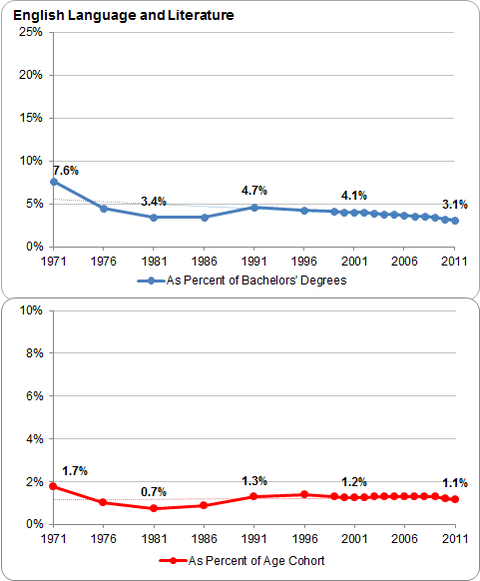
 Nate Silver argues that the English major isn’t withering.
Silver says that more people are going to college than ever before, and the new students are getting degrees in health, criminal justice, and business. In the past, they probably didn’t need college degrees in those fields.

 Apt. 11d
Yes, I think this is an unfortunate trend – not because it is bad for students who want to go into construction management, hospitality, marketing, or law enforcement to come to college, but because a lot of the classes they take (from what I hear) are really not necessary for the jobs they’re going into. It just *looks* good that they’ve done this, but probably they could have a traditional major, maybe take a class or two in those fields, and do just as well in that job. Based on the samples I’ve heard about from my students, the “practical major” classes are easy, very slow-paced, and don’t require much reading or writing (lots of multiple-choice tests). I’ve had some terrific students who majored in dietetics, tourism, or criminal justice but took as many upper-level classes in our department as they possibly could, because they were bored to death with classes in the major.
LikeLike
It’s possible that the college world is fundamentally misconceived when considered as a unity, and only makes sense when examined by strata. So maybe English majors are declining at the very top tier (that would account for yesterday’s numbers from Yale), holding steady in the middle tiers (that would account for Silver’s aggregate numbers), and non-existent at the bottom tier, where students major in dietetics and the like. The decline of English at the top tier may reflect the belief that economics and poli sci are more helpful for the relatively narrow range of career options that Ivy students consider (basically law school and jobs in finance).
This stratified examination would also support something I have said before, that the growth in female undergraduates is not occurring at the top tier (HYP being 50/50, and MIT, Caltech etc. being heavily male), but rather at the bottom. Future HVAC repairmen (I mean that last syllable) go to commercial schools, whereas future pink collar workers go to college to earn degrees in medical office administration.
I don’t know if I consider the growth of the educational bottom tier to be unfortunate. To the extent those institutions supply mostly pink collar training, their growth may be a natural reflection of that growing workforce.
LikeLike
It would be interesting to see the earlier numbers on English, but I’d venture that its peak in 1971 probably represents the high water point of English as an MRS degree, as well as the high water point of teaching as a career goal for women.
LikeLike
I had the same thoughts as y81 on reading the SIlver article, that group trends were likely to be very different in the different substrata of college education (the same issue I have with state level analyses of anything at all). The overall trends might be important for public policy but not if we’re imagining what it might be like to be a student at Yale.
The Yale trends (pretty dramatic — cranberry — have you found similar info for the other elite schools?) might be irrelevant to any place but Yale (perhaps not even generalizing to other ivies) and the explanation that many students are focused on finance jobs might be a big part of the explanation of the employment trends at Yale.
LikeLike
Working on it… I’ve found some articles and reports. It’s not a Yale phenomenon. I suggest we should widen the debate to the field of Humanities, rather than restrict it to English majors.
To add to my pessimistic thoughts of yesterday, I came up with a theory over lunch which could explain part of this observed phenomenon at the top end of the nation’s academic institutions. In this theory, I blame a lack of grammar instruction in elementary school, coupled with writing instruction which preps kids to do passably well on two fronts: standardized exams, i.e., NCLB and SAT writing exams (5 paragraph essays), and the College Application Essay (All About Me! With Epiphanies!)
A student who does not possess a basic knowledge of English grammar will find it difficult to write at length on a topic. Even with spell check, you must have the vocabulary and knowledge of sentence structure to be able to proofread your own typing. What you don’t like to do, you will avoid. English and History, in my long ago college days, required a great deal of writing and reading.
In those days, many students typed their papers by hand. There was mainframe computer, but it frequently ate student papers. And yet, more students chose to major in subjects which demanded lots of reading, writing, and typing.
As an aside, how much is all this influenced by internet plagiarism and cheating (i.e., papers-for-hire shops)? Even if high school students should be writing papers, do they? A teacher assigns a paper, a student hands one in…but did he write it? Or copy it? Or buy it? Only the first option exercises his essay-writing skills.
LikeLike
Harvard just released a report on the teaching of the arts and humanities at Harvard College (link is in the fourth paragraph of this Harvard Magazine article): http://harvardmagazine.com/2013/06/reinvigorating-the-humanities.
Among the data-driven findings: the percentage of humanities concentrators fell during the last 60 years from 24 to 17 percent, dropping between 2003 and 2012 from 21 to 17 percent. When history concentrators are factored in (history is considered part of the humanities, although at Harvard it is technically in the division of social sciences), the decline in concentrators since 1954 is even more precipitous, falling from 36 to 20 percent of undergraduates.
Dartmouth has had a decline in the number of new students choosing the humanities: http://www.dartblog.com/data/2013/06/010633.php.
Princeton: compare two profiles, one from 2000: http://www.princeton.edu/pr/profile/00/05.htm, to the 2011-12 profile: http://www.princeton.edu/pub/profile/academics/the-college/.
History decreases from 252 majors to 141. English decreases from 182 majors to 113. Two majors appear in the top 12 majors for 2012 which were not in the top 12 for 2000, Sociology and “Operations Research and Financial Engineering”.
LikeLike
I’m confused by the argument that students at the Ivies (and their ilk) are flummoxed by the obligation to write and read in English majors as a motivation for not choosing the subject. Is that really an accurate reflection? Silver cited a stat on the decrease in average verbal SAT scores, but has there been a decrease at the elites? Do some of the majors that have increased in popularity (sociology, anthropology ) require less writing and reading than English (or at least enough less that someone who feels weak in that skill would chose it?
I could see the lack of skills as being an explanation for a shift in English majors at the middle tier of schools, but am wary of seeing the lack of sufficient skill being an explanation at the Ivies (though the ability to purchase papers does give me some pause).
I recently signed up for an introductory psychology MOOC (for which I took one quiz/test, but haven’t participated in otherwise). I receive periodic emails about the class, and the latest said that in the peer evaluation of a project, plagiarism has been a huge issue. The issue was a big surprise to the course leader, because he didn’t think anyone would bother to cheat in a no-credit course. Changing standards could be undermining education even at the highest levels, if the students just don’t understand the point of the educational exercises.
LikeLike
Do they not understand the point? Or do they behave as they have been trained to behave? The grade is all that matters, and any method to achieve that grade is acceptable. Is education intended to educate, or to rank and sort? As a parent, I don’t accept the “poor dears, they don’t know any better, and besides, it’s collaboration, (or “using the internet for research”), not cheating…” line of argument. They know. Now, if no one in authority through their school careers has bothered to look for cheating, nor to enforce consequences, students will cheat because the rewards of cheating are so much larger than any risk involved.
I found Denise Clark Pope’s book, _Doing School_, informative. It was published in 2001. The subjects of the book should be finished with school by now. At that time, Pope stated she observed students in the school she studied cheating all the time. In effect, they collaborated with each other within the confines of the school’s structures. It is against students’ own self interest to talk about a test with peers who happen to have the same test later in the day, and yet they do it.
Reading and writing demand time. It’s hard to fit in the time to read lots of material, synthesize a response, then craft a well-written paper, when you’re deeply involved in multiple activities on campus. Written work in English and History is more likely to take the form of papers, not problem sets. It’s easier to prove plagiarism when the work is supposed to be your own creation. Problem sets are likely to be easier to copy from peers (as alleged in _That Book About Harvard_), because there’s one right answer for a problem.
The problem may arise from admissions criteria. If schools look for students who are “leaders on campus” in their high school years, yet have high test scores and grades, they’re likely to select some students who have learned how to cut corners. After all, Harvard’s admissions department was taken in by Adam Wheeler.
LikeLike
“The problem may arise from admissions criteria. If schools look for students who are “leaders on campus” in their high school years, yet have high test scores and grades, they’re likely to select some students who have learned how to cut corners.”
Yes.
With regard to writing quality at elite schools, I can’t say if it’s gotten better, but I do know that when my husband was teaching at an elite college l (10% admission rate), the students came into the institution with very good writing skills. Those students hit the ground running, and as we joked, they’d do ANYTHING for a good grade–even do the work. At the time, those elite kids were often thinking about finance jobs (this was pre-meltdown). That was in stark contrast to the non-elite colleges he’s taught at, where the students do need to be taught very, very basic stuff (as a TA at a non-elite school, my husband once got a paper handed in that was printed in VIOLET printer ink).
LikeLike
As a recent graduate, I am a graphic designer but I graduated with a degree in marketing and taught myself the necessary skills on my own through undergrad. I can definitely say I obtained a marketing degree on the basis of practicality.
LikeLike