
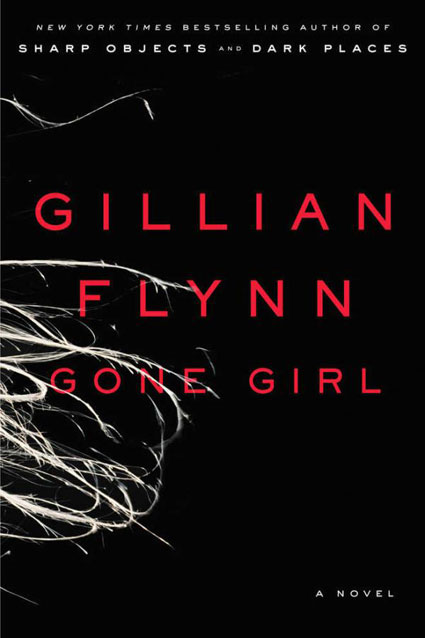
When Nick discovers the truth about his wife's abduction, his lawyer tells him to keep quiet. It was too complicated a story, he said. Juries and the public wouldn't be able to follow a complicated reality. People like simple, predictable stories, like "the husband did it." Nick needed to package an alternative story that the public could latch onto.
Gone Girl
is just that. A simple, well-packaged novel with one twist that happens in the middle of the book, but it lacks depth and some basic believable characters. [Spoiler alert!! ]

A wife, Amy, is missing. All signs point to the husband, Nick. Halfway through the book, we learn that the chapters that were written in the wife's voice were works of fiction. (It's very meta.) Her diary was all lies and was designed to frame her cheating husband. We learn that we've been manipulated, just like all the other characters in the story. The wife eventually comes home and manipulates the husband even further to keep their marriage together.
That's how the book was sold to publishers. I could probably hone that last paragraph down to a single catchy sentence, the elevator pitch. Publishers want the quick blurb, the neat-o concept, the dramatic title. The words inside don't matter so much. They just want to make that book sale, knowing that most books sit on a coffee table and are never actually read.
Gone Girl is all pitch, and not enough substance. Amy is a two-dimensional psycho – unbelievable at times and inconsistent other times. The supporting characters are too predictable and wooden to feel real. She had no idea of what to do with Nick at the end.
The most honest voice in the book comes from the lawyer, who sneers at the stupidity of the public and their ability to be manipulated. Gillian Flynn, the author, takes this message to heart. She's giving us a well-packaged story, and we're buying it for our book clubs and our coffee tables. Like Amy, she researched the science of pitches and mystery novel plotlines and the formula for bestsellers, and gave us just that.
Call me old fashioned, but I don't like books that assume I'm stupid and easily manipulated by formulas and book club-friendly plot lines. I want a book that is more than a pitch, please.

 Apt. 11d
I am not a publishing expert, so I do not know how much of this book resulted from a pitch. But the author had already published two books, which were well received if not best sellers, and the publisher presumably was committed to her for at least another book.
LikeLike
I thought I was the only one who felt this way about Gone Girl. It was overhyped, which I know contributed to my lukewarm feelings. I waited for my turn with the book at our local library for six months – the longest wait I’ve ever experienced – only to feel really let down. It did not live up to expectations. I had a feeling by page 50 that the wife was not at all what she seemed, so after that point it felt like I was just waiting for my suspicions to be confirmed, which they were.
It’s a cleverly packaged and marketed book, but one that didn’t satisfy in the end. In my opinion, Ruth Rendell and Minette Walters (among others) do this sort of thing much more artfully. Frankly, I’m surprised by all the effusive reviews. I read one on The Guardian just last week and thought, “Really?” I’d be interested to know if fans of mystery fiction rate this book less favorably than people who don’t read a lot of mysteries. My guess is that they would.
But I agree with you about the lawyer. He was by far the most entertaining character.
LikeLike
I recall similar criticisms to The Firm when it was published, but Grisham has stood the test of time, having at time received praise from those in the literary establishment.
LikeLike
I don’t know if it’s as shallow as you portray, Laura. I think it takes a great deal of skill to create a novel that introduces a flawed narrator. And certainly Gone Girl is a step above the typical thriller/mystery genre normal fare.
My problem with Gone Girl is that it’s not as smart as I want it to be. Flynn had a great idea with the mechanism of the narrative. The problem was that she didn’t know how to end it. The result is that the last few chapters simply are not remotely credible to the point of being insulting.
I don’t want to have spoilers, so I’ll be oblique here: can you imagine that person as a parent? How could the final manipulation actually result in the family staying together? No. Way.)
But as to the success of the bok — I think it’s largely deserved. Here is a book that is clever and takes risks. The backlash of failure is invariably stronger when expectations are high. I’d rather read flawed works that have real aspirations than the pablum that doesn’t bother.
LikeLike
Gone Girl totally sucked me in. I read it on a long day of flying and then spent three more hours finishing it that night. My book club read it but I think it’s more in the category of Grisham or Tom Clancy. It’s an absorbing read, and the basic premise with her as an unreliable diarist was a good one, but there was just too much crazy stuff in the second half. And yes, the end was ridiculous.
LikeLike
I think Grisham is unreadable, though it was that movie with Denzel Washington that made me decide to never try to read a book by Grisham again.
I think there’s a trend towards “video game” books that have the flaws that Laura describes. They seem to be written for the page, and not the entire book.
Also, did anyone else read the article in (NYT or Wash Post, I can’t find it easily now) talking about the use of data-driven targeting to edit screenplays? An interesting read that explains part of my complete disenchantment with current movies. The (single company) expert uses statistical analysis from past performance of movies to give advice like “bowling scenes decrease the box office by 10%” to provide editing advice on movies.
When I discussed the article with my daughter she pointed out the obvious: that such editing should result in one generic movie that everyone is making. Seems like a technique that should only work if people only watch one movie. But, potentially, it could also work if they are looking for rote experiences, like being sung the same lullaby night after night in order to go to sleep.
Interesting future, when these data techniques actually are effective enough to be helpful in reaching a goal (for example, winning an election or making a block buster movie, or choosing a company to invest in).
LikeLike
For a while (when I was in the business) there was a trend of making a huge deal about a novel’s first sentence. I’ve always thought that Suicide Blonde by Darcey Steinke was sold on the basis of its opening sentence (which is arresting), and the publisher was indifferent to the modest quality of the rest of the book.
The Dogs of Babel by Carolyn Parkhurst seemed like what’s under discussion here: a novel that was sold on the basis of its premise/gimmick but doesn’t follow through/live up to expectations. In Parkhurst’s case, the characters would have made for a fine novel without the gimmick but that wasn’t (I surmise) how the book was sold nor how the publisher planned to market it.
A slightly gimmicky novel (in mainstream commercial fiction) that does deliver on its promise is The Secret History by Donna Tartt. On the other hand, for the superstitious out there, it may be an object lesson in the danger of putting “This is the only story I shall ever tell” at the end of your first novel’s introductory chapter.
LikeLike
For a while (when I was in the business) there was a trend of making a huge deal about a novel’s first sentence. I’ve always thought that Suicide Blonde by Darcey Steinke was sold on the basis of its opening sentence (which is arresting), and the publisher was indifferent to the modest quality of the rest of the book.
The Dogs of Babel by Carolyn Parkhurst seemed like what’s under discussion here: a novel that was sold on the basis of its premise/gimmick but doesn’t follow through/live up to expectations. In Parkhurst’s case, the characters would have made for a fine novel without the gimmick but that wasn’t (I surmise) how the book was sold nor how the publisher planned to market it.
A slightly gimmicky novel (in mainstream commercial fiction) that does deliver on its promise is The Secret History by Donna Tartt. On the other hand, for the superstitious out there, it may be an object lesson in the danger of putting “This is the only story I shall ever tell” at the end of your first novel’s introductory chapter.
(Trying again, as the blog gnomes may have eaten my first posting)
LikeLike
Or at least that’s how it looks from here.
LikeLike
In Orwell’s 1984, there are novel-writing machines.
LikeLike
Where’s your tip jar, Laura? I feel like I need to pay for some content that hasn’t been written by a data-driven marketer.
LikeLike
After I read Gone Girl, I felt like I needed a shower. I just felt … besmirched by the whole experience of reading it. I found it compelling while reading it, but I agree about the end.
LikeLike
Sorry dudes about the stupid spam filter. I’m working on a project right now, but in a week or two, I really have to start shopping around for a new blogging platform. I’m dreading the whole transferring process. I might have to pay someone to take care of it for me. If I do, I’m going to hit you all up for cash.
LikeLike
Squarespace – just sayin’…
LikeLike
My missing post partly concerned this sentence, “Was it the bourbon or the dye fumes that made the pink walls quiver like vaginal lips?”
That is all.
LikeLike
Doug, I hope it was the bourbon.
LikeLike
PS: And I hate myself for saying “content”.
LikeLike
PS: And I hate myself for saying “content”.
LikeLike
I might have to pay someone to take care of it for me. If I do, I’m going to hit you all up for cash.
Are there giant, poorly built, comment-tending factories in Bangladesh?
LikeLike
THe NYT article on big data and script editing:
LikeLike
@Wendy, my reaction was about the same. I read it on a flight, enjoyed how the flawed narrator was being handled (although I think The Gargoyle was better at it) and then – ewww.
LikeLike
I really loved this book although, I can totally see where you’re coming from
LikeLike
Alright, I have to admit that I was a little grouchy when I wrote this review. I enjoyed 3/4rds of the book quite a bit. I am in the process of putting together a book pitch and I am so, so, so bad at writing book pitches. Maybe I’m a little jealous of a book that was clearly packaged so very well.
LikeLike
I read it when it first came out, when there was no hype yet and I was blown away. I think that’s because it did seem different from anything else out there, and I wasn’t expecting anything. I assume they’re making it into a movie?
LikeLike
No idea. The only thing I remember about the book is the opening sentence. (Though did double-check at Amazon before quoting it.)
LikeLike