
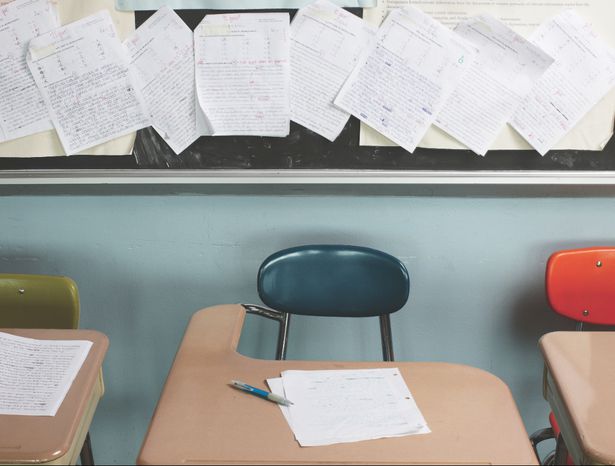
 For those of us who really care about education policy, the lack of writing in schools is one of our pet peeves. I see it even my own high achieving school district. Kids don't do enough writing.
I've complained about the lack of writing in schools to various principals for years. If they are responsive principals, they respond by hiring a consultant who does workshops for the teachers. The schools buys some expensive writing packages that involve lots of worksheets for the kids. And then things settle back to the status quo, which is about two essays per year. If principals are unresponsive, they deny everything and tell me to shut up.
Here's a good essay in the Atlantic about how writing is an important skill that kids need to learn.
Perhaps writing would happen more often, if the teachers who assign writing projects were paid more than other teachers. Grading written assignments takes a lot of time. It's way harder to read 50 essays than 50 multiple choice tests that can be mechanically graded. It takes a lot patience and time to show individual kids how to improve their writing style. The teachers who assign these papers are grading them on Sunday nights. They should be paid for their time.
However, that's not how it works in American schools. All teachers are paid the same, depending on the education level and their years of service. So, a gym teacher who has no prep work and no grading gets paid the same amount as an English teacher. The English teacher has no incentive to assign projects that use up their weekends and burns them out.
We could encourage writing in schools, not by a new writing philosophy or system, but by adjusting the pay scales of teachers.


As an English teacher, I totally agree that more money would be great, but then, I think all teachers should be paid more!
Better instruction on how to effectively teach writing, whether it be in graduate school, through professional development, on-site writing coaches and consultants, whatever–would also be great. Writing well is a very sophisticated and layered skill, and difficult to teach if you yourself are not a great writer. Of course, class size is also a big factor here–keep our salaries the same if you must, but don’t put more than 20 kids in our classes, with a total teaching load of no more than 80, as the NCTE has recommended for over a decade.
I teach ninth grade, so I see the students who have been at my (private) school since kindergarten, as well as students who come from a wide variety of public/private middle schools across our urban/metropolitan area. The biggest dividing factor is not what they know about grammar or vocab, or how many books they read for school, but whether or not they have been exposed to much writing instruction in middle school. It can take years for them to catch up to what our 8th graders are capable of doing. Additionally, what we hear over and over from our students, when they return from college and come visit, is that they are shocked by what their college classmates do or don’t know about writing. I had a U of Chicago freshman tell me recently that she had classmates who didn’t really understand what a thesis statement was–she was appalled!
LikeLike
I think talking about “being paid for our time” is tricky though, because the majority of teachers, regardless of the subject, works hours and hours they don’t get paid for, doing lesson planning and class prep, leading clubs and doing one-on-one sessions, just as we all take on more roles than simply “teaching,” such as counseling and social working. It’s part of the education game to know you’re going to bring work home.
LikeLike
I second the point about class size. At my university there are certain writing requirements for classes under 50, and then even more stringent requirements for our small freshman-only seminars. If I have 20 students I assign more papers and give more feedback than if I have 50. At a high school, you could hire twice as many English comp teachers and give them half as many students. I’m sure this is wildly unrealistic, but it seems to me to be the best solution.
LikeLike
I have no firm ideas about teaching writing, but if people want extra money, you should consider smuggling cheese into Canada. It would probably be a good job for our status-free, nuetrally-dressed Washington State friends.
LikeLike
YES! Pay writing teachers more! 🙂
I teach on the college level, and I’d like to know if any history or biology professors set up one-on-one meetings with all the students in any of their classes. Because that’s what I’m doing this coming week. All 23 of my advanced comp students, 1/2 hour each, and I’m actually scheduled to go in today, on my “day off,” to meet with 2 of them.
I can’t do this when I have 2 sections of comp because I literally do not have enough time, but it’s so crucial. It makes such a huge difference to have a good editor talk with you about your writing. And if you have grammar problems, it makes a huge difference to have a good teacher teach you about how grammar works.
When it comes to writing instruction, experience is key. I am so much better at teaching writing now than I was back when I was a snotty grad student at Duke. I am a better writing teacher now than 9 years ago when I started teaching at my current job. I’ll be even better in 9 more years, if I’m not burned out!
LikeLike
I’m not sure it is actually possible to teach writing outside of encouraging reading. You can (and somebody really needs to) teach grammar but that is only a necessary (not a sufficient) condition for writing.
LikeLike
“I’m not sure it is actually possible to teach writing outside of encouraging reading. You can (and somebody really needs to) teach grammar but that is only a necessary (not a sufficient) condition for writing.”
I agree. I find a lot of what I do now is to substitute for the fact that so few of my students read voraciously.
My personal theory about writing skills weakness among college students is pretty much developmental. I think that their ideas are growing more complex, but they lack the knowledge of the variety of sentence structures out there and how they should be properly used.
The other night I corrected my husband on a grammatical misconception he had, but the thing is, he was grammatically correct. He just didn’t understand the grammar rule he was following. But since he reads so much, he *knows* correct grammar use. He knows what’s right; he just doesn’t know why. My students don’t know what’s right, and they don’t know why. I teach them the why so they can do it right. But ideally, they would know what is right first.
LikeLike
I was trying to troll you so I didn’t have to work.
LikeLike
While I agree that teacher pay should be based on something other than education level and years of service, I’d like to point out that the school profiled by the Atlantic achieved a turnaround with no change to pay. Changing the curriculum and teaching methods were what made the difference.
They dumped the fluffy “discovery” teaching of personal narratives and memoirs for a curriculum that stressed a systemic process, along with explicit grammar instruction and a strong focus on sentence composition. As a parent who has endured years of math memoirs (“What I like best about math”), unstructured writing assignments that simply received a check if completed, and English essays with the “creative” cover designs counting for a quarter of the grade, I would welcome such a change. From what I’ve seen of the typical public school writing curriculum, I’m not surprised that college professors and employers complain their students cannot write.
Revolutionary writing instruction that is ‘an old idea done better’
LikeLike
“I was trying to troll you so I didn’t have to work”
LOL. Wouldn’t have worked because I left the computer for a while. 🙂
LikeLike
MH
I smuggled some cheese in from Europe. I think it was my REI polar fleece and hiking boots that got me past the customs agents.
LikeLike
I, in fact, abandoned the idea of teaching writing at the college level because the pay seemed too low for work. I would have taken a pay cut to teach 4 comp classes of 22-25 students each, 3 preps. I have 5 preps now and run 3 clubs, but I don’t take much work home. I have fewer students, and in 3 of my classes, there’s no homework. So I’m only grading final projects. With fewer students, I can usually get the grading done at school.
I also make my CS students write. We have a blog, and they write a paper for every project. Everyone should know how to write well. They complain about it, but I explain that CS folks who can communicate well end up further up the career ladder than those who can’t.
LikeLike
I was made to write lots in college and in high school — for two years I wrote 3x 1000 word essays every two weeks, and then one week for the next three years. I was still a very indifferent writer at the end of that process (I’m a good writer now — I became one 2 years into tenure track). I have students who are much better writers than I was, and have written, maybe 20 essays in their lives. Every one of them is a voracious reader. They just have learned so much from seeing what others do. Expecting students to learn to write without having read, is like expecting them to learn to sing without having heard anyone sing. Imagine trying to learn to pitch in baseball without having watched anyone do it, and then, while learning, continuing not to watch anyone do it.
In short, what MH said flippantly and Wendy agreed with seriously.
LikeLike
If I recall correctly where you are located, I expected my flippant comment about cheese smuggling would be the one that hit home for you.
LikeLike
Wendy–
I’m a professor in the physical sciences, and I meet with each student in my senior-level class once per week. I do it for my classes of 8, not for my classes of 75, though!
LikeLike
In the towns near us, teachers receive stipends to mentor after-school activities and clubs. The gym teacher likely coaches the school’s sports teams, which is an enormous time commitment. The coaches must undergo regular training to keep their certification.
My two high school students write well. They both read voraciously, which gives them an “ear” for written conventions. However, grammar instruction is essential. My daughter received no effective grammar instruction in her public middle school. She had a great deal to learn in her freshman year at her current high school. It’s difficult or impossible to improve one’s writing when one doesn’t understand the vocabulary of writing, i.e., grammar. Antecedent? Coordinating conjunction? Past participle? If you don’t know the technical terms, any feedback on grammar errors will go right over your head.
History teachers and religion teachers have been very effective at teaching writing. Receiving feedback on writing makes all the difference.
This is unfortunately an area in which a gulf can open up between students, based upon parents’ willingness to supplement their children’s education. I have heard parents refer to their children’s “writing tutor.” I don’t know if the instruction extends to how to write an essay.
LikeLike
http://www.theatlantic.com/magazine/archive/2012/10/the-writing-revolution/309090/3/?single_page=true
This article was fascinating.
LikeLike
You know what improved my writing skills? Blogging every bloody day for eight years.
LikeLike
Great job you people are doing with this website.
http://backlinksvault.com/
LikeLike